Two planning researchers, one a professor at Tufts and another independent, make the case against apps as a panacea for urban problems.



Julian Agyeman and Duncan McLaren write a dissenting take on the trend of cities seeking the latest in "smart city" technology. According to their argument, "our current smart-city techno fetish rides roughshod across the public realm." Moreover, it "encourages the belief that there’s always 'an app for that' — that we can address deep-seated, structural urban problems through business-led technological innovation and somehow sidestep the messiness of inclusive politics."
As evidence to back up those claims, Agyeman and McLaren first cite the example of a partnership between the city of Boston and Waze, the Google-owned navigation app (not to be confused with the city of Boston's partnership with Uber, which has been the subject of recent criticisms). Despite seeming like a great idea, according to Agyre, and McLaren, the partnership with Waze "merely represents a Band Aid slapped over a problem that still requires brave new political thinking and much-needed infrastructure investment." Agyeman and McLaren's response to the problems of congestion would employ congestion pricing and transit investments, rather than relying on the effects of Waze's data-collection system.
Read the full story: Apps don’t make a city smart

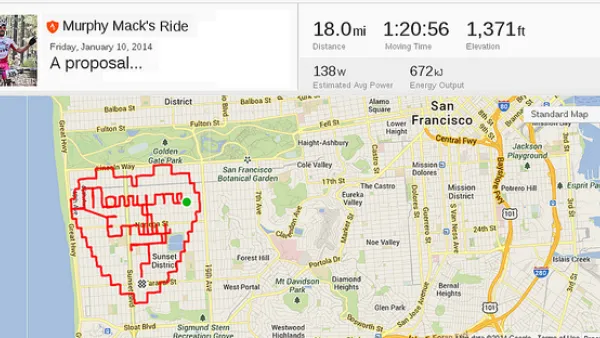
Fitness Apps Are the New Planning Tool
Many smartphone users have a fitness app that they use to track their routes and progress on fitness goals. The data in these apps is a gold mine for planners, helping lead to better infrastructure investments.
The Power of Public-Private Partnerships: Mobile Phone Apps and Municipalities
Private, crowdsourced mobile phone applications addressing urban mobility collect troves of data on how cities flow. So how can municipalities tap into these databases to accurately understand the movement of their citizens?
Boston Mayor Plugs Into Big Data
New Boston Mayor Martin J. Walsh has installed a large data dashboard in his office to track the performance of everything from city services, hot line call volume, and social media sentiment.

Planetizen Federal Action Tracker
A weekly monitor of how Trump’s orders and actions are impacting planners and planning in America.

Amtrak, CN end decades-long dispute with eight-year agreement
The new operating agreement establishes an updated framework for the companies to work together, including processes to resolve disputes.

Nation's most wind-powered state turns to coal as data centers increase energy demand
For the first time in decades, Iowa has increased its generation of coal power.

Alabama scores up to $2.5 billion federal loan for largest infrastructure project in state’s history
The Mobile River Bridge and Bayway Project aims to ease congestion at Alabama’s worst bottleneck.

Trump is considering data centers on 6 states' public land — some state officials say they had no idea
If the administration approves the proposed projects, data center and data center-related developments will cover 17,600 acres of public land.

Despite court ruling, Trump is keeping nearly all wind projects in the US on hold
At least 110 wind energy projects have not heard from the government since a federal judge ruled that the Trump administration's freeze on wind turbine clearances was likely illegal.

FREE Course: Walkable City 1: Why Walkability?
After describing his path towards focusing on walkability as the essence of good planning, Jeff Speck marches through his five principal reasons for making more walkable places.
Reinventing Malls: Planning Alchemy—Turning Gray Fields Into Gold
The course focuses on the opportunities and imperatives that shape reinvention of mall sites.

KFH Group Inc.
Greater Baltimore Committee
Eagle County Government
The Architects Foundation
University of Cincinnati Online
The Pocatello Development Authority
The Urban Renewal Agency of the City of Pocatello