A case is made in the Orange County, California, city of Garden Grove for protected bike lanes. And a new protected bike lane opens in Southern California's bike infrastructure capital, Long Beach.


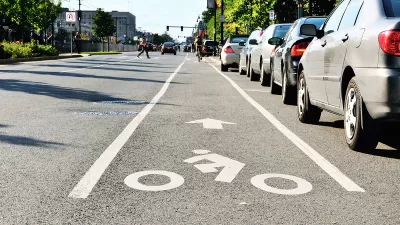
Good news for walkers and cyclists in Orange County, California. After years of seeing bike and pedestrian funding left unused, the Orange County Transportation Authority "awarded about $19.5 million to six Orange County cities and the county for bicycle and pedestrian mobility projects," reports Erika Aguilar for KPCC, Southern California Public Radio. "It had double the number of project pitches and funding requests." [Listen here.]
The money comes from the federal Congestion Mitigation and Air Quality Improvement program, [aka CMAQ] which provides funding for projects that meet the Clean Air Act requirements.
Garden Grove, fifth largest of the 34 cities in the county, "received $1.1 million from OCTA to make improvements," notes Aguilar. But is designating bike lines with white stripes and bike icons on the right shoulder of existing roadways enough?
Data shows that "the city's existing bike lanes are under-utilized," reports Aguilar.
The city counted bicyclists last September and in the report, released in June, found the majority rode on the sidewalk. A full 40 percent chose to ride on the sidewalk even when bike lanes were present.
Byron Von Korper, owner of Papa Wheelie Bicycles in Garden Grove, said the city "needs to take a page from the city of Long Beach where some bike lanes are separated from vehicle traffic, have physical barriers from the street, and their own traffic signals," adds Aguilar.
The comparison to the second most populous city in Los Angeles County is a good one. According to an April 2011 Streetsblog LA article by Joe Linton, "Long Beach is Southern California’s undisputed leader in innovative infrastructure for safe and convenient bicycling." That month the city "unveil(ed) the first genuine protected bike lane [running on Third Street and Broadway] west of New York City."
On Thursday, the city celebrated the opening of the Artesia protected bike lane, reports Linton.
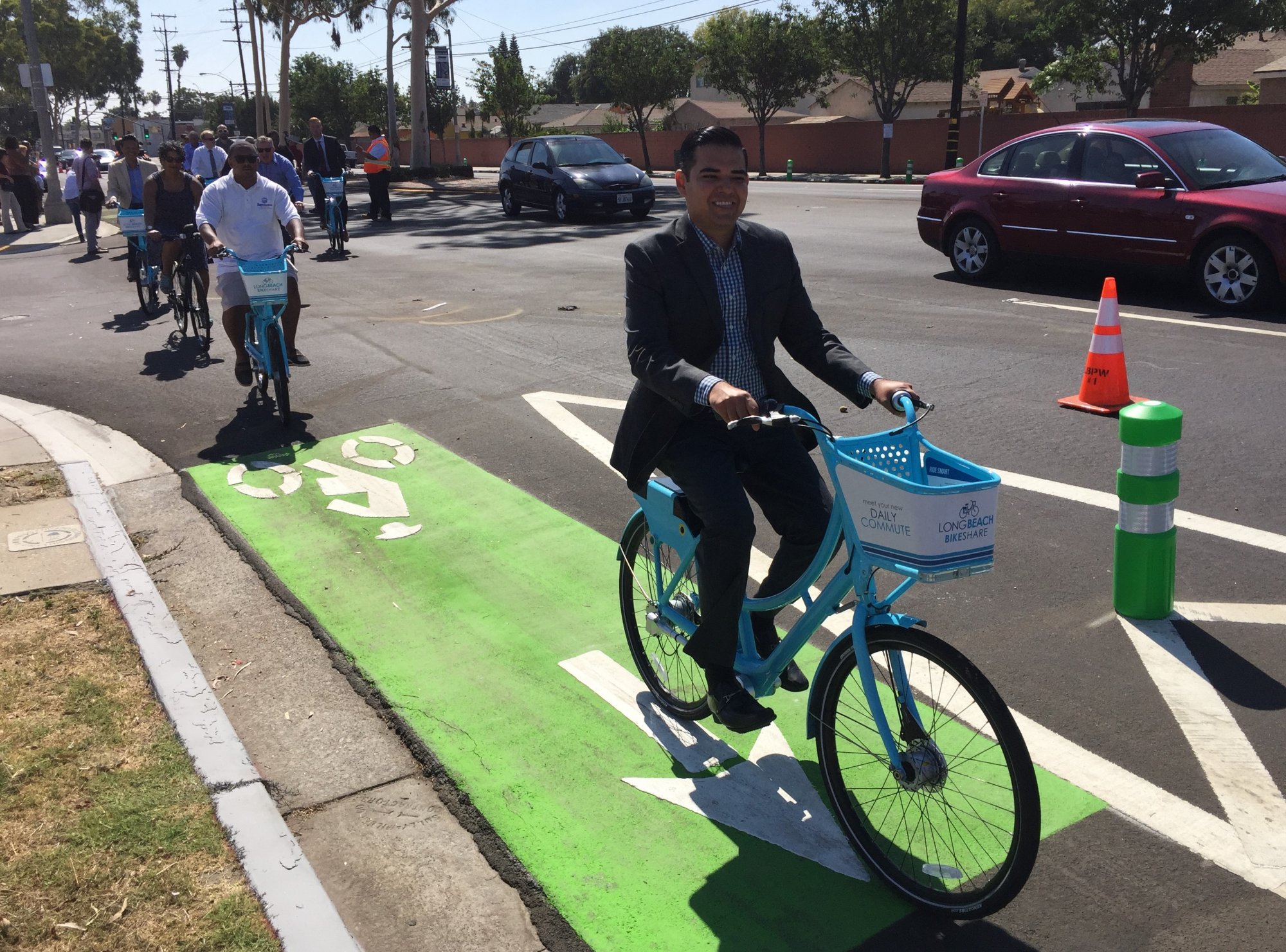
Long Beach Mayor Robert Garcia (center) and Vice Mayor Rex Richardson (left, white shirt) tour the new Artesia Blvd protected bike lanes. Photos: Joe Linton/Streetsblog L.A. [Permission given.].
The lanes are parking-protected, and feature green plastic reflective bollards, rubber curbs, and intermittent green pavement markings.
Note the photo with temporary signage directing where motorists should park and where cyclists should ride in the parking-protected bike lanes.
Notably absent are bicycle traffic signals. Linton explains:
At approaches to intersections and at bus stops, the protection drops and there is a merge zone marked with dashed green pavement. (Not dropping the protection would require relatively expensive bikeway signals, similar to Long Beach’s Broadway/Third couplet.)
The event highlighted Long Beach Bike Share which began operation on March 19, 2015.
Finally, the transition in bike planning in Orange County, going from undersubscribed to oversubscribed, reflects what was the topic of a "post peak car" discussion (posted Saturday) among transportation experts on the future of planning in urban centers.
"The push for more bike infrastructure comes with Orange County's transition from a bedroom community to a dense urban environment," notes Aguilar.
OCTA awarded Santa Ana, the county seat and second most populous city after Anaheim, "$4.4 million in funding for three projects that will add protected or buffered bike lanes," adds Aguilar.
Hat tip to AASHTO Daily Transportation Update.
Read the full story: Bike lane projects become popular in Orange County

OC Streetcar Breaks Ground After Receiving Full Funding Grant Agreement
It's only the third full funding grant administration signed by Transportation Secretary Elaine Chao. The $149 million capital investment grant will help fund the 4-mile modern streetcar line from Santa Ana to Garden Grove in Orange County, Calif.

Las Vegas is building its first protected bike lane
The new lane connects Henderson and the Las Vegas Raiders headquarters via Starr Avenue.

Nashville installs concrete barriers to protect bike lanes
The new 'Toronto barriers' provide a physical buffer between cars and bike lanes.

Planetizen Federal Action Tracker
A weekly monitor of how Trump’s orders and actions are impacting planners and planning in America.

‘Going backwards:’ Baltimore mayor, students rally against state's transit funding plan
Maryland's proposed six-year plan provides no funding for Baltimore’s BMORE bus program and reduces its road maintenance funding.

Detroit to transform waterfront with $2.2 billion investment
Developers will convert about 18 acres of unused parking lot space into civic spaces.

MIT to create AI-powered hub for public transportation companies
Google awarded the project, titled the Public Transit Intelligence Hub, $2.1 million in funding.

A 3D concrete printer may solve Virginia’s housing crisis
The printer is able to build concrete walls much faster than humans, and can do so directly at job sites.

Newsom vetoes high-speed rail supervision bill after agency receives condemnatory audit
The audit found the CHSRA approved almost $600,000 in unallowable travel expenses.

FREE Course: Walkable City 1: Why Walkability?
After describing his path towards focusing on walkability as the essence of good planning, Jeff Speck marches through his five principal reasons for making more walkable places.
Reinventing Malls: Planning Alchemy—Turning Gray Fields Into Gold
The course focuses on the opportunities and imperatives that shape reinvention of mall sites.

City of Thousand Oaks
City of Wisconsin Rapids
Harvard University Graduate School of Design
The Architects Foundation
University of Cincinnati Online
Northern Illinois Transit Authority (NITA)
The Pocatello Development Authority
The Urban Renewal Agency of the City of Pocatello