Not only would a new $150.6 billion proposal build a high-speed rail project to connect Sydney and Melbourne, it would also build eight new cities along the way.


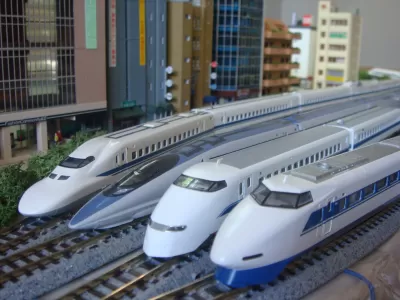
A high-speed rail proposal in Australia has the lofty ambition of solving some of the country's largest housing and transportation challenges, "by building eight new cities inland from the coast and connecting them with Sydney, Melbourne and the national capital of Canberra with a new high-speed rail line."
The proposal is novel in its scale and ambition. The company behind the proposal, Consolidated Land and Rail Australia Pty. Ltd. (CLARA), "says that the new cities will be compact, walkable 'smart cities,' with power from renewable sources, open data networks, mixed-use activity districts and local transport systems that would enable residents to live within 10 minutes of all their daily needs. And the housing, of course, will be affordable." CLARA announced the proposal earlier this month.
The proposal drops some big, glossy numbers: namely trains traveling at a speed of 430 km/h (267 mph) and a pricetag of A$200 billion ($150.6 billion U.S.). So far, CLARA has already dropped A$10 million ($7.5 million U.S.) on advance planning work.
Read the full story: A Radical, $150 Billion Plan for High-Speed Rail in Australia

Checking in on the Bicycle Backlash
Alan Davies writes from Down Under about a recent controversy in the Australian media about the “menace” of cycling in the urban core—where some are tired of the bicycle lobby's advancements of its cause.
Is Australia's Housing Bubble About to Burst?
With residential property prices ten times the average salary in Melbourne and Sydney, U.S. forecaster Harry Dent expects the Australian market to mirror the collapse witnessed in the California.

Picturing Ten Urban Qualities Important for Every City
Writing in The Atlantic Cities, Chuck Wolfe provides ten illustrated examples of enjoyable environments that reflect an evolving recognition for the qualitative aspects of the urban experience.

Planetizen Federal Action Tracker
A weekly monitor of how Trump’s orders and actions are impacting planners and planning in America.

Amtrak, CN end decades-long dispute with eight-year agreement
The new operating agreement establishes an updated framework for the companies to work together, including processes to resolve disputes.

Judges permit Denver to divert 77,000 acre feet from the Colorado River for reservoir expansion
Overuse and climate change have caused the Colorado River’s water levels to plummet.

NYC DOT wants faster, more permanent street upgrades
The city is examining ways to build more concrete infrastructure without getting entangled in 'decades-long' projects.

'Something we’ve never seen before:' rising utility rates could strain city finances nationwide
Data centers, climate change and other factors have caused utility rates in the United States to increase by 38% since 2020.

Trump to overrule local leaders, lease millions of acres of America’s Pacific Island territories’ seafloors to mining companies
International law says that the Indigenous people of America’s territories have a right to prior and informed consent regarding projects that impact their countries.

FREE Course: Walkable City 1: Why Walkability?
After describing his path towards focusing on walkability as the essence of good planning, Jeff Speck marches through his five principal reasons for making more walkable places.
Reinventing Malls: Planning Alchemy—Turning Gray Fields Into Gold
The course focuses on the opportunities and imperatives that shape reinvention of mall sites.

Harvard University Graduate School of Design
KFH Group Inc.
Greater Baltimore Committee
The Architects Foundation
University of Cincinnati Online
The Pocatello Development Authority
The Urban Renewal Agency of the City of Pocatello