After Monday's celebrations at the new, electrified commuter rail line's only two stations, Union Station and Westminster Station, commuters now have the option of taking an 11-minute, six-mile ride to Denver, costing $2.60.


"The Westminster stop is supposed to be the first in a 44-mile commuter rail system that is planned to connect Boulder and Longmont," reports Monte Whaley for The Denver Post. "But because of a variety of issues, including lack of funding, the rest of the B-Line likely will not be finished before 2030." [See last week's post.]
Like the 23-mile, eight-station A Line from Union Station to Denver Airport that began service on Earth Day, the B Line will be electrified using the Silverliner V electric multiple unit (EMU) cars that had to be pulled from service by the Southeastern Pennsylvania Transportation Authority (SEPTA), but have not caused any problems for the Regional Transit District (RTD).
According to the RTD Fastracks Northwest Rail Line factsheet [PDF], the remainder of the line, from Westminster to Longmont, "will use diesel-powered commuter cars."
While everyone in the above Denver Post video is happy with the new rail service, at least one public official was upset—not because the line didn't extend farther to the northwest, as the earlier post indicated, but with the rail line itself.
“I see this project as opening another sore, another wound on RTD which will hemorrhage from for years to come,” Westminster city councilman Bruce Baker said in the CBS article and accompanying video.
Baker believes the money could have been better spent in Denver, leaving the suburb of Westminster alone.
“All we’ve become is the vassal of Denver. We’ve become the servants of Denver,” Baker said
More tellingly, CBS reported that one else had bad words for the new line.
"Besides convenience, the B-Line is expected to spark retail and housing development, including the 42 acres just south of the station, Westminster Mayor Herb Atchison said," adds Whaley.
In The Denver Post video, Atchison elaborates on the new station area developments. He also explains that past Westminster, RTD has to share trackage rights with BNSF Railway, complicating matters, and explaining why diesel-powered trains will be used on that part of the line.
Two more lines to open this year:
RTD expects to open the G-Line — from Union Station to Arvada and Wheat Ride — this fall and the R-Line — which will run along Interstate 225 — is slated to open at the end of the year.
The G Line will be commuter rail and the R Line is a light rail line extension.
Read the full story: B-Line from Westminster to Union Station opens Monday to fanfare
Opening of Denver's B Line Bittersweet for Commuters From Northwest Suburbs
The 6.2 mile, two-station electrified commuter rail line is opening as expected next Monday, July 25, but future service to the northwestern counties of Broomfield and Boulder will be delayed due to an unexpected funding shortfall.
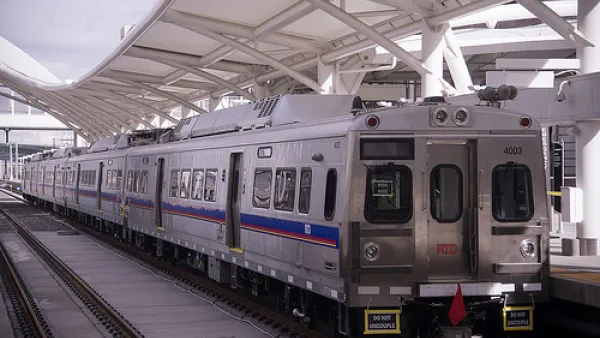
Denver's Commuter Rail Cars: Same as SEPTA's But Without the Defects
Denver's transit agency is running very similar Hyundai Rotem EMUs on their new A Line to the airport. The car shells are imported from South Korea and assembled in the same Philadelphia plant as SEPTA's problem-plagued Silverliner V cars.
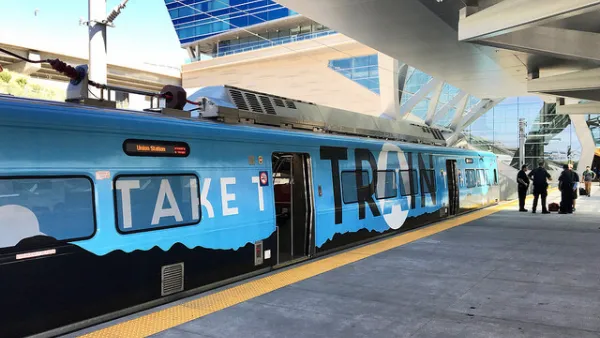
Denver's New Commuter Train to the Plane Achieves Record Ridership
Ridership on the electrified A Line, which opened to great fanfare on Earth Day, reached a weekday average of 16,910 as of June 5. The 23-mile line operates from Union Station to Denver International Airport. Not all is perfect though.

Planetizen Federal Action Tracker
A weekly monitor of how Trump’s orders and actions are impacting planners and planning in America.

California plans to bury El Niño’s downpour
If the state plays its cards right, it may be able to store a billion acre-feet of El Niño’s water in aquifers.

Desperate measures: Advocates weigh draining Lake Powell to fill Colorado River
Draining the reservoir could reduce evaporation losses by a couple hundred thousand acre-feet.

Los Angeles just elected an urban planner as its mayor
Transportation analysts are optimistic that Raman will be more aggressive in addressing transit issues than Bass.

Mamdani’s pied-à-terre tax survives legal challenge
A panel of judges found that the plaintiffs failed to demonstrate injury as a result of New York City's implementation of the tax.

Eastern Nebraska is running out of electricity
Data centers and electrification are straining eastern Nebraska’s grid, throttling economic development.

FREE Course: Walkable City 1: Why Walkability?
After describing his path towards focusing on walkability as the essence of good planning, Jeff Speck marches through his five principal reasons for making more walkable places.
Reinventing Malls: Planning Alchemy—Turning Gray Fields Into Gold
The course focuses on the opportunities and imperatives that shape reinvention of mall sites.

City of Rosemead
Rutgers University, Edward J. Bloustein School of Planning and Public Policy
One Hundred Miles
University of Michigan School for Environment and Sustainability (SEAS)
Hunter College, City University of New York (CUNY)
The Architects Foundation
City of Cambridge
Montrose County
The Pocatello Development Authority