The leadership at the city of Seattle has noticed that the people representing neighborhoods on the city's district councils don't reflect the population of the city.


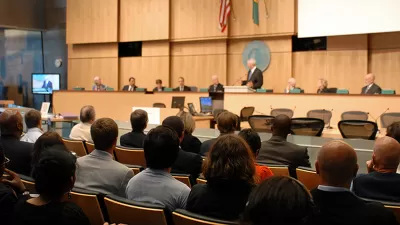
Seattle Department of Neighborhood Director Kathy Nyland "is the driving force behind a major policy shift that [Mayor Ed] Murray is set to announce today," according to an article by Josh Feit. That is, Mayor Murray will propose replacing the district council system with a proposed "Community Involvement Commission."
Testifying in front the city council last month where, presenting data that showed a discrepancy between who’s on the city’s 13 community councils (older, white, homeowners) versus who lives in the city (median age 36, majority renters, and a 34 percent nonwhite population), Nyland said the community councils represented a “narrow, niche,” and concluded, “they don’t work for everyone [and] it’s unclear that the existing district council system is sufficiently flexible to meaningfully serve as a voice for all Seattle residents.”
According to Feit, the policy proposal would "retool the Department of Neighborhood’s approach to community outreach so that community input into city policy is driven by a more inclusive formula than the current model where district councils are the default voice on neighborhood policy." The article includes examples of how that would work—and a description of the potential political resistance the proposal could encounter.
Read the full story: Plastic Bag Ban Noncompliant, District Councils Not Working


Mandatory Housing Affordability Details Released in Seattle
Seattle has released the long-awaited environmental impact statement for the Mandatory Housing Affordability program—a final step in the Housing Affordability and Livability Agenda process launched by former Mayor Ed Murray.

How Seattle Is Curbing the Power of Neighborhood Groups
In Seattle, City Hall wants to open the neighborhood planning process to new demographics. The changes have rattled traditional neighborhood councils.

Seattle's New Updated Pedestrian Master Plan Includes $22 Million for Sidewalks
The promised update for the city of Seattle's Pedestrian Master Plan was released to the public last week.

Planetizen Federal Action Tracker
A weekly monitor of how Trump’s orders and actions are impacting planners and planning in America.

The state-sanctioned urbicide of Austin
People don’t kill cities. Freeways do.

Colorado’s Largest Data Center Could Rise Next to Homes — Without a Public Hearing
The proposed campus would consume 11 times the power of Denver International Airport; as it has across the country, opposition mounts.

Amtrak, CN end decades-long dispute with eight-year agreement
The new operating agreement establishes an updated framework for the companies to work together, including processes to resolve disputes.

Raised interest rates may kill financially vulnerable construction projects
The chief economist at ConstructConnect warns that if construction project owners are negatively impacted by the raised rates, it could result in delayed payments to contractors.

Data centers are consuming nearly 25% of Oregon’s power
The state has 111 data centers, with 32 more either planned or under construction.

FREE Course: Walkable City 1: Why Walkability?
After describing his path towards focusing on walkability as the essence of good planning, Jeff Speck marches through his five principal reasons for making more walkable places.
Reinventing Malls: Planning Alchemy—Turning Gray Fields Into Gold
The course focuses on the opportunities and imperatives that shape reinvention of mall sites.

Greater Baltimore Committee
Eagle County Government
Harvard University Graduate School of Design
The Architects Foundation
University of Cincinnati Online
The Pocatello Development Authority
The Urban Renewal Agency of the City of Pocatello
Journal of the American Planning Association