A pair of legislative proposals in the Pennsylvania State Legislature would open the door to private development in the state park system.


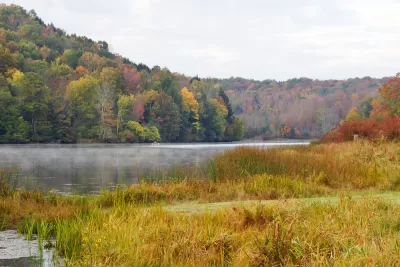
"Rep. Brian Ellis (R., Butler) wants to amend the 1995 Conservation and Natural Resources Act to allow development of those recreational and lodging amenities, along with the establishment of a new, politically appointed Public-Private State Park Partnership Board to propose and oversee development projects," reports Don Hopey. Think "golf courses, hotels, inns, restaurants, amusement parks, water slides, and other outdoor sports facilities."
Hopey's coverage surveys the reactions of politicians and environmental groups to the proposed legislation by Ellis. Environmentalists spoke out to support the state park system, as it currently functions and exists, and also voiced concerns that the bill is a precursor to more aggressive development plans that would turn the state's parks into "piggy banks."
Hopey also notes a bill proposed by Rep. Jim Christiana (R-Beaver), who would create the Arnold Palmer Trails Program. According to a memo from Rep. Christiana announcing the bill, the program would direct the Pennsylvania Department of General Services "to establish a minimum of four golf courses (north, south, east and west regions) located within four of Pennsylvania’s 121 state parks, which encompass over 200,000 acres of land."
Read the full story: Proposals would open state parks to golf, water slides and hotels
Proposed Bills Would Protect Funding for Texas State Parks
When lean times hit, money for state parks is some of the first to get diverted to other purposes. A package of legislation proposed in the Texas State legislature would change that.
California gets three new state parks
The state plans to add 30,000 additional acres to the state parks system by the end of the decade.
California's State Library Park Pass Program Renewed Amid Budget Challenges
Californians can continue to access state parks for free by borrowing passes from their local libraries, thanks to the renewal of a state program.

Planetizen Federal Action Tracker
A weekly monitor of how Trump’s orders and actions are impacting planners and planning in America.

California plans to bury El Niño’s downpour
If the state plays its cards right, it may be able to store a billion acre-feet of El Niño’s water in aquifers.

Desperate measures: Advocates weigh draining Lake Powell to fill Colorado River
Draining the reservoir could reduce evaporation losses by a couple hundred thousand acre-feet.

Mamdani’s pied-à-terre tax survives legal challenge
A panel of judges found that the plaintiffs failed to demonstrate injury as a result of New York City's implementation of the tax.

Eastern Nebraska is running out of electricity
Data centers and electrification are straining eastern Nebraska’s grid, throttling economic development.

Seattle passes record-breaking transit services expansion
Proposition 1 will double the city’s transit tax to add 95,000 more bus trips and preserve 180,000 bus trips annually.

FREE Course: Walkable City 1: Why Walkability?
After describing his path towards focusing on walkability as the essence of good planning, Jeff Speck marches through his five principal reasons for making more walkable places.
Reinventing Malls: Planning Alchemy—Turning Gray Fields Into Gold
The course focuses on the opportunities and imperatives that shape reinvention of mall sites.

City of Rosemead
Rutgers University, Edward J. Bloustein School of Planning and Public Policy
One Hundred Miles
Hunter College, City University of New York (CUNY)
The Architects Foundation
University of Cincinnati Online
City of Cambridge
Montrose County
The Pocatello Development Authority