As economic migration continues to swell its population, Texas has been heralded by some as a new California. But Johnny Sanphillippo argues that the Lone Star State's boom just isn't sustainable.


Anyone who's searched for housing in California these days can understand the appeal of Texas. Despite (or because of) its powerhouse economy, California is losing a stream of migrants to its rival and peer.
California's troubles have been debated ad nauseam. Johnny Sanphillippo writes, "Conservatives love to blame pointed headed liberals and their tree-hugging tendencies for the decline. Liberals love to blame conservatives and their thinly veiled racism and greed. But it was absolutely a group effort with plenty of overlap. [...] Don't tax me was the middle ground everyone coalesced around from Marin to Orange County. Don't change the character of our community echoed from San Francisco to Costa Mesa."
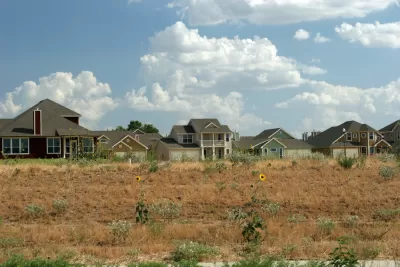
But the economic charms of Texas may soon fade. Risks include an environmentally and fiscally unsustainable pattern of development and the state's conservative politics, which will likely forestall California-style regulation. "There may be an endless amount of flat easily developed land in Texas, but the cost of maintaining an equally endless amount of horizontal infrastructure will inevitably outstrip tax revenue over the next generation. The Texas Department of Transportation is already hitting the wall in terms of revenue-to-expenditure."
Moreover, "Texas has long enjoyed the booms of hydrocarbon production and muddled through the busts of low oil and gas prices. But the cheap, easily extracted stuff is mostly gone after a century of drilling. [...] At a certain point, even Texas will have to start making hard choices about how to keep all the cars and air conditioners humming along in a low cost, low tax, low regulation environment."
Read the full story: Texas Is the New California, But It Won't Last


EPA Terminates $116 Million in Grants for Reducing Emissions from Construction Materials
C-MORE grants were earmarked for industry trade groups and universities.

How Smart Street Lights Can Help Cities Achieve Sustainability Goals
Switching to energy-efficient LEDs and using tech to program when and how street lighting operates can save cities millions in electricity expenses and bring down carbon emissions.

Art in Action: USC Event Calls for an Urgent Green Energy Transition
The El Respiro / Respire event at USC uses a large-scale human geochoreography to demand an urgent and equitable transition to green energy, blending art, activism, and community engagement to amplify the message of climate justice.

Planetizen Federal Action Tracker
A weekly monitor of how Trump’s orders and actions are impacting planners and planning in America.

Amtrak, CN end decades-long dispute with eight-year agreement
The new operating agreement establishes an updated framework for the companies to work together, including processes to resolve disputes.

Judges permit Denver to divert 77,000 acre feet from the Colorado River for reservoir expansion
Overuse and climate change have caused the Colorado River’s water levels to plummet.

NYC DOT wants faster, more permanent street upgrades
The city is examining ways to build more concrete infrastructure without getting entangled in 'decades-long' projects.

'Something we’ve never seen before:' rising utility rates could strain city finances nationwide
Data centers, climate change and other factors have caused utility rates in the United States to increase by 38% since 2020.

Trump to overrule local leaders, lease millions of acres of America’s Pacific Island territories’ seafloors to mining companies
International law says that the Indigenous people of America’s territories have a right to prior and informed consent regarding projects that impact their countries.

FREE Course: Walkable City 1: Why Walkability?
After describing his path towards focusing on walkability as the essence of good planning, Jeff Speck marches through his five principal reasons for making more walkable places.
Reinventing Malls: Planning Alchemy—Turning Gray Fields Into Gold
The course focuses on the opportunities and imperatives that shape reinvention of mall sites.

Harvard University Graduate School of Design
KFH Group Inc.
Greater Baltimore Committee
The Architects Foundation
University of Cincinnati Online
The Pocatello Development Authority
The Urban Renewal Agency of the City of Pocatello