'Huge' is an understatement. Revenues were less than 2 percent of what was forecasted. The uncertainty of the continuance of the program may be responsible. The plummet in revenues to high-speed rail adds to uncertainty of the $64 billion project.


The nation's only cap-and-trade program run by a state suffered an unanticipated setback when insufficient buyers purchased carbon allowances at the quarterly auction this month.
"The results of last week’s quarterly auction were posted [PDF] and revealed that instead of the $500-plus million expected from the sale of state-owned allowances, the state will get only about $10 million, less than 2 percent," writes Dan Walters, columnist for The Sacramento Bee.
The poor results confirmed reports circulating in financial circles that the cap-and-trade program has begun to stumble...but whether it’s a one-time dip or the harbinger of a more permanent down-market is uncertain.
[Gov.] Brown has submitted a plan to spend $3.1 billion in auction proceeds in 2016-17, both leftover funds from past auctions and an estimated $2 billion from those during the fiscal year. The plan covers a wide variety of projects and programs [see below], including a major allocation to support the state’s high-speed rail project.
High-speed rail
"The quarterly auction, conducted May 18 and announced [May 25], will provide just $10 million for state programs, including $2.5 million for the bullet train," writes Ralph Vartabedian for the Los Angeles Times. "The rail authority had been expecting about $150 million."
Whatever prompted the lack of buyers, the auction is a stark example of the uncertainty and risk of relying on actively-traded carbon credits to build the bullet train, a problem highlighted in recent legislative testimony by the Legislative Analyst's Office and a peer-review panel for the $64-billion high-speed rail.
The rail authority's recently released 2016 business plan had counted on getting about $10.6 billion from the greenhouse gas fees through 2050, about half of it by borrowing on the future income stream in about 2025.
"How all this affects high-speed rail’s budget is uncertain," writes Melody Gutierrez for the San Francisco Chronicle.
Jessica Peters, principal fiscal and policy analyst for the Legislative Analyst’s Office, said the rail authority is mostly relying on federal money now, but plans to use cap-and-trade revenue once it begins building its planned line to San Jose.
Peters said the analyst’s office found it problematic that the rail authority’s business plan relies heavily on the cap-and-trade revenue in future years, particularly given that the program is authorized only through 2020.
Effect will be felt on other programs as well.
The reduction in revenue will be felt by affordable housing programs, the state Transit and Intercity Rail Capital Program, efforts to reduce carbon emissions by transit agencies and the Low Carbon Transportation Investments and Air Quality Improvement Program run by the California Air Resources Board (CARB).
Future of cap-and-trade
While the California Air Resources Board states that it shall continue the program after the authorizing legislation, AB 32, the California Global Warming Solutions Act of 2006, ends in 2020, there is some degree of uncertainty. The landmark legislation called for reducing state greenhouse gas emission to 1990 levels by 2020. The legislature attempted unsuccessfully to renew the legislation last year.
"There’s a fierce, albeit mostly private, debate over whether the cap-and-trade system can legally exist after 2020, or would have to be reauthorized by the Legislature," adds Walters. "Meanwhile, there’s a pending lawsuit, filed by business groups, that seeks to have the system branded a tax, which would require a two-thirds legislative vote."
Vartabedian lists three reasons for the dramatic drop in revenues, with one being positive from a climate change perspective: AB 32 is working, and major emitters have dramatically cut emissions. However, the explanation could be simpler:
David Clegern, a spokesman for the state Air Resources Board, said he believed the auction results reflected simple volatility.
Read the full story: California carbon emission auction proceeds fall short

Future of California's Climate Agenda in Peril
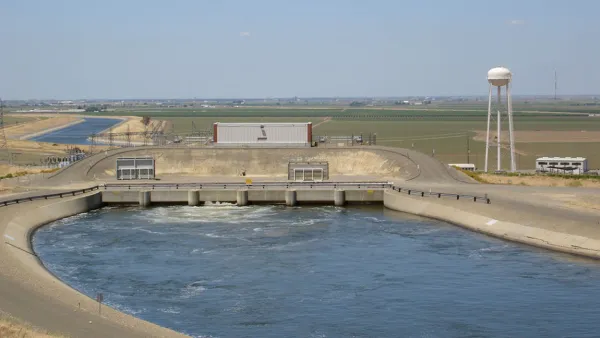
Legislation to reauthorize the California Global Warming Solutions Act of 2006 is in peril due to 'a powerful bloc of business-friendly Democrats' who are uneasy about its impact on businesses, particularly Big Oil, due to higher energy costs.
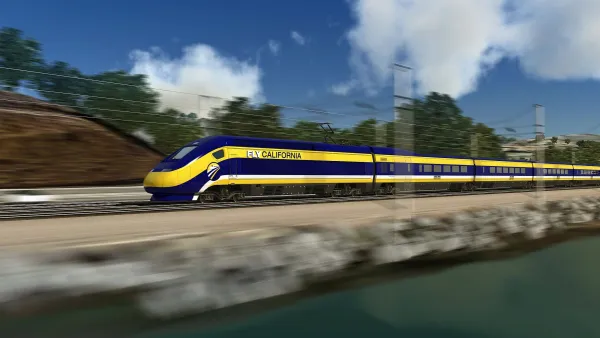
California's High-Speed Train to Nowhere?
Don't tell that to the 18,000 residents of Shafter. However, the Legislative Analyst's Office made clear in its March 17 report that it questioned having the southern end of the first operating segment located "in an unpopulated agricultural area."
California First: Carbon Fees Used to Fund Affordable, Transit-Oriented Housing
On June 29, the California Strategic Growth Council awarded $121.9 million in Greenhouse Gas Reduction Funds to help build 28 affordable housing developments on major transit lines. Funding originates from proceeds of the cap-and-trade market.

Planetizen Federal Action Tracker
A weekly monitor of how Trump’s orders and actions are impacting planners and planning in America.

California plans to bury El Niño’s downpour
If the state plays its cards right, it may be able to store a billion acre-feet of El Niño’s water in aquifers.

Chicago breaks ground on $3 billion megadevelopment
The new neighborhood, titled Foundry Park, will one day host 3,700 residences.

Satanic Place Names
From streams and lakes to valleys and canyons, I mapped more than 1,000 places named after the Devil.

California High-Speed Rail Authority CEO resigns after $600,000 scandal
Under Ian Choudri, the authority used taxpayer dollars to fund first class flights and trips to nightclubs.

Want to study the Missouri River? Soon, you may need unanimous approval from 10 states
Legislation would require 10 governors’ permission to study or build projects moving water outside the basin.

FREE Course: Walkable City 1: Why Walkability?
After describing his path towards focusing on walkability as the essence of good planning, Jeff Speck marches through his five principal reasons for making more walkable places.
Reinventing Malls: Planning Alchemy—Turning Gray Fields Into Gold
The course focuses on the opportunities and imperatives that shape reinvention of mall sites.

City of Rosemead
Rutgers University, Edward J. Bloustein School of Planning and Public Policy
One Hundred Miles
Hunter College, City University of New York (CUNY)
The Architects Foundation
University of Cincinnati Online
City of Cambridge
Montrose County
The Pocatello Development Authority