After stakeholder engagement and an international design competition, Agence Ter's plan for "radical flatness" has been selected to replace downtown L.A.'s current Pershing Square. The preferred alternative is, above all, simple.


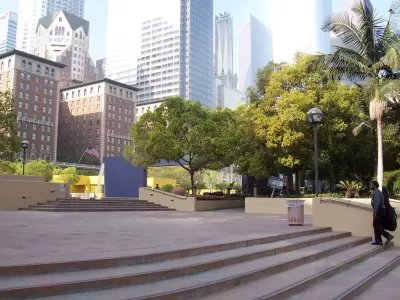
The campaign to renew Los Angeles' Pershing Square has reached a turning point: a design has been selected, and now the pressure's on to fund and build. Last week, the public-private partnership Pershing Square Renew announced that Agence Ter, a French landscape design firm, will remake the confused space into something resembling an actual park.
For the LA Times, Christopher Hawthorne writes, "The winning design focuses on opening the park directly to the sidewalks around it, replacing concrete with grass and providing extensive new pockets of shade. It is very much a reaction to, if not an outright apology for, the visual clutter of present-day Pershing Square, which remains a conspicuous dead space in an otherwise revived and money-soaked downtown."
Compared to its rivals in the design competition, the Agence Ter plan calls for fewer topographical alterations, its "radical flatness" clearly appealing to the jury selected to review the designs. Central to the new design is an open lawn, with shade trees on one side and an expansive "smart canopy" on the other, topped with solar panels. Pershing Square's underground parking garage will remain, but it will no longer rise above sidewalk level, giving pedestrians easy access to the central lawn.
The new design will be implemented, but questions remain about funding and a timetable. The current goal is 2019, but that's assuming City Hall is fully on board and enough private funding comes through. Even so, it's an exciting development in a placemaking saga that encapsulates downtown L.A.'s ongoing renaissance.
Read the full story: French landscape firm wins Pershing Square competition with call for 'radical flatness'

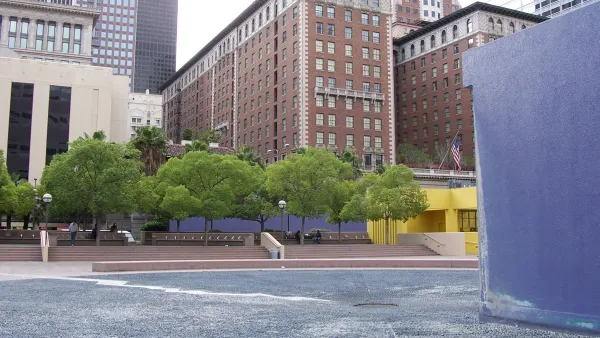
Los Angeles to Redesign Its 'Worst Public Space'
Josh Stephens reports on the Pershing Square Renew Design Challenge, an effort to redo one of the "world's worst squares and plazas." The new Pershing Square may hearken back to the years before its misguided 1992 redesign.
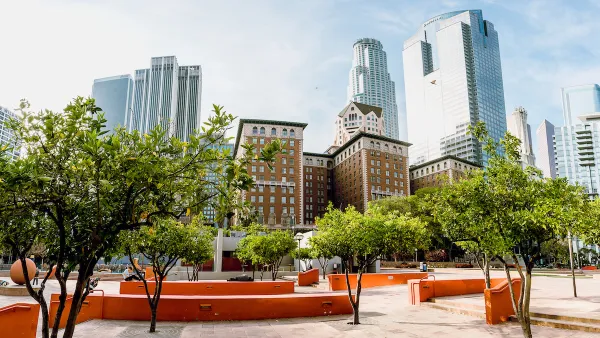
Pershing Square, Downtown L.A.’s ‘Forgotten Park,’ Begins Long Awaited Revamp
A makeover that began in 2015 is finally underway in 2023, but the process of reconstructing Pershing Square is expected to proceed incrementally.
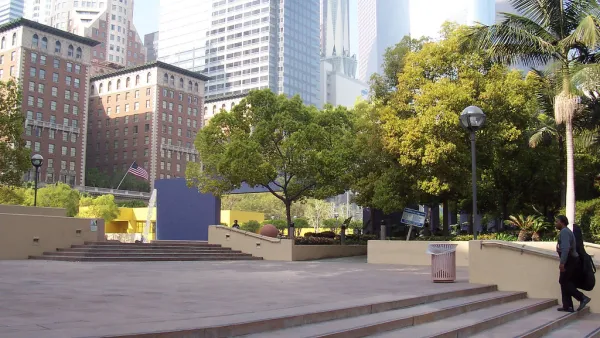
L.A.'s Pershing Square Headed for Redesign
The first phases of a plan to remake the downtown Los Angeles plaza into a more inviting, accessible public space are going to kick off soon.

Planetizen Federal Action Tracker
A weekly monitor of how Trump’s orders and actions are impacting planners and planning in America.

California plans to bury El Niño’s downpour
If the state plays its cards right, it may be able to store a billion acre-feet of El Niño’s water in aquifers.

Chicago breaks ground on $3 billion megadevelopment
The new neighborhood, titled Foundry Park, will one day host 3,700 residences.

One of Denver’s busiest corridors to gain BRT
The project will span 18 miles and contain 74 bus rapid transit stations.

275,000 bus trips are at stake on Seattle's ballot
If passed, the Seattle Transit Measure would trigger a 0.3% sales tax and raise an average of $138 million per year to maintain and expand Seattle’s bus services.

Texas may pay Israeli company billions to ease water woes
Texas awarded IDE Technologies the contract for its Harbor Island project, which is slated to become the Western Hemisphere's largest desalination plant.

FREE Course: Walkable City 1: Why Walkability?
After describing his path towards focusing on walkability as the essence of good planning, Jeff Speck marches through his five principal reasons for making more walkable places.
Reinventing Malls: Planning Alchemy—Turning Gray Fields Into Gold
The course focuses on the opportunities and imperatives that shape reinvention of mall sites.

City of Rosemead
Rutgers University, Edward J. Bloustein School of Planning and Public Policy
One Hundred Miles
Hunter College, City University of New York (CUNY)
The Architects Foundation
University of Cincinnati Online
City of Cambridge
Montrose County
The Pocatello Development Authority