One interesting detail to note: the BQX streetcar proposal, as its currently known, originated not from the de Blasio Administration but from a Brooklyn-based real estate company.


Dana Rubinstein has the scoop on the details of a city-commissioned report to study the Brooklyn-Queens Connector streetcar (BQX) proposal announced in February of this year.
The article reveals a few surprising details, the first being that the BQX was "dreamed up by executives at Two Trees, the DUMBO-based real estate company owned by the Walentas family." Also included are details about projected ridership, projects costs, and travel times. Rubinstein also reports that about" 70 percent of the route would get a dedicated right-of-way."
That last detail inspired Yonah Freemark to tweet his reactions to Rubinstein's article. Freemark's tweets include a reference to a February column he wrote to describe the necessary planning decisions for a successful BQX.
BQX, as I suspected, will have considerable portions without its own ROW. It also will run at 10.5 mph, not 12 mph as previously reported
— Yonah Freemark (@yfreemark) April 25, 2016
Sad to see concerns in my op-ed from Feb coming true, despite what consultants told me https://t.co/yRMHDPHZ4X https://t.co/v9qRr8FRsK
— Yonah Freemark (@yfreemark) April 25, 2016
FULL STORY: City gives new BQX streetcar details, and revs up outreach plan

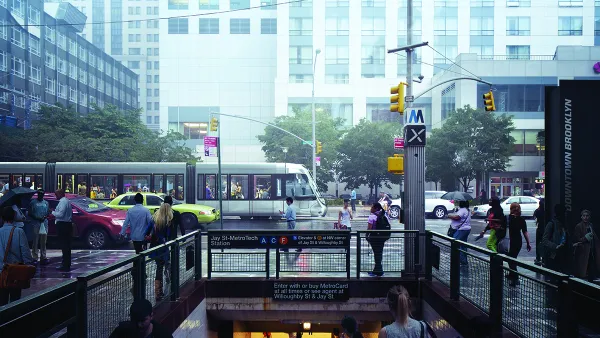
Brooklyn-Queens Connector Streetcar Plans Released
Plans for the Brooklyn-Queens Connector, otherwise known as the BQX, are still on the table, despite reports of the project's demise.
Brooklyn Queens Streetcar Hopes to Learn from D.C. Streetcar's Mistakes
The long-awaited opening of the D.C. Streetcar on Feb. 27 brings time for reflection on Mayor Bill de Blasio's proposed $2.5 billion Brooklyn Queens Connector, part streetcar, part light rail. D.C.'s line took a decade of planning and construction.
Concerns Raised About the Brooklyn-to-Queens Streetcar Proposal
We've gathered a sample of the responses to Mayor Bill de Blasio's proposal for a $2.2 billion streetcar to connect Brooklyn to Queens.

Planetizen Federal Action Tracker
A weekly monitor of how Trump’s orders and actions are impacting planners and planning in America.

The state-sanctioned urbicide of Austin
People don’t kill cities. Freeways do.

US to reduce Colorado River water deliveries to Mexico
A new Colorado Treaty amendment reduces Mexico’s Colorado River water allocation by 250,000 acre feet.

Mamdani overhauls NYC's Vision Zero plan with 100 new policy goals
The overhaul aims to reduce traffic deaths and make streets safer for pedestrians, cyclists and drivers through lower speed limits, new safety infrastructure and more.

Amtrak not solely to blame for New Jersey commuter rail's unreliability, report finds
A new study from the Garden State Initiative found that NJ Transit’s budget grew 20% across a 4 year period, but reliability declined significantly over the same period.

EPA erases limits on planet-warming pollution from power plants
Under Monday’s plan, power plants would still have some limits on how much mercury, arsenic and other contaminants they can emit.

FREE Course: Walkable City 1: Why Walkability?
After describing his path towards focusing on walkability as the essence of good planning, Jeff Speck marches through his five principal reasons for making more walkable places.
Reinventing Malls: Planning Alchemy—Turning Gray Fields Into Gold
The course focuses on the opportunities and imperatives that shape reinvention of mall sites.

Eagle County Government
Harvard University Graduate School of Design
Nashville Planning Department
The Architects Foundation
University of Cincinnati Online
The Pocatello Development Authority
The Urban Renewal Agency of the City of Pocatello
Journal of the American Planning Association