A Quartz article describes the recent announcement of the Model 3, and the subsequent response by the market, as a "slow-motion disruption of the global auto industry."


"On March 31, his Tesla Motors unveiled its long-promised Model 3, a $35,000 electric car that will go 215 miles per charge," reports an article by Steve Levine. Most importantly, however, is how the market has responded, with levels of demand for a new car, unprecedented "in more than a century of automotive history." According to Levine, "The market response suggests to some the potential as a category killer, not just in electric vehicles, but mainstream cars in general."
In the week since the Model 3 was unveiled, "more than 325,000 Model 3s have been pre-ordered by people putting down $1,000 per reservation," reports Levine.
The question posed by the article, is if Tesla is about to perform a similar feat to what Apple did to Nokia when it announced the iPhone—overthrow a company completely dominating an industry with high barriers to entry, thus "[reconfiguring] the commercial landscape and [transforming] society."
The article concludes by considering the various factors that will determine whether Tesla succeeds or fails in this monumental effort.
Read the full story: We are now witnessing Elon Musk’s slow-motion disruption of the global auto industry

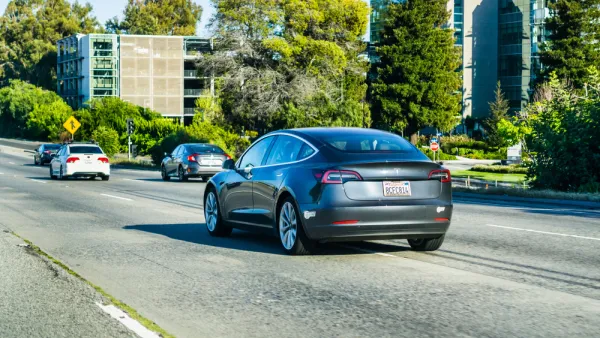
Time for a Tesla Turnaround?
The Tesla Model 3 is now America's best-selling electric vehicle. The news follows a spate of bad news for the Silicon Valley-based electric vehicle manufacturer.
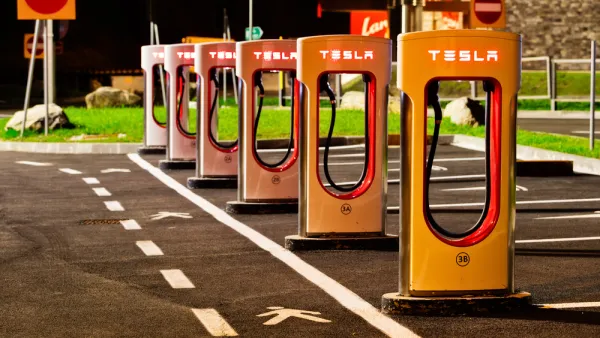
More Bad News for Tesla—This Time From the EPA
A rollback of fuel economy standards carries huge financial consequences for the all-electric vehicle manufacturer that makes over $300 million annually by selling credits to auto manufacturers unable to achieve current fuel economy standards.
Tesla Fatal Crash and Battery Fire Under Investigation
Wei Huang, a 38-year-old Apple engineer, died after his Tesla Model X collided with a highway barrier on a Bay Area highway interchange on March 23. NTSB wants to know if it was operating on Autopilot. It took 5 hours to reopen the freeway.

Planetizen Federal Action Tracker
A weekly monitor of how Trump’s orders and actions are impacting planners and planning in America.

California plans to bury El Niño’s downpour
If the state plays its cards right, it may be able to store a billion acre-feet of El Niño’s water in aquifers.

Desperate measures: Advocates weigh draining Lake Powell to fill Colorado River
Draining the reservoir could reduce evaporation losses by a couple hundred thousand acre-feet.

California city breaks ground on transit connector
The project includes three mobility hubs and a pedestrian bridge.

After public outcry, Massachusetts city releases housing development tracker
Cambridge’s tracker currently shows 250 housing projects in various stages of development.

40 years after approval, Chicago breaks ground on new park
The park honors Jean Baptiste Point du Sable, the city’s first permanent non-native settler.

FREE Course: Walkable City 1: Why Walkability?
After describing his path towards focusing on walkability as the essence of good planning, Jeff Speck marches through his five principal reasons for making more walkable places.
Reinventing Malls: Planning Alchemy—Turning Gray Fields Into Gold
The course focuses on the opportunities and imperatives that shape reinvention of mall sites.

City of Rosemead
Rutgers University, Edward J. Bloustein School of Planning and Public Policy
One Hundred Miles
Hunter College, City University of New York (CUNY)
The Architects Foundation
University of Cincinnati Online
City of Cambridge
Montrose County
The Pocatello Development Authority