A long-discussed, and perpetually controversial, proposal to close Rock Creek Park to automobile traffic is headed toward construction. Questions about the impact of the project remain.


"Work to reconstruct a nearly 6.5 mile stretch of Beach Drive, from Rock Creek Parkway to the Maryland line, will start soon," according to an article by David Cranor. "That will mean closing a section of the road that the National Park Service, environmentalists, and cyclists have long wanted to close but that motorists and some neighbors have fought to keep open."
According to the article, the work to close the road in Rock Creek Park culminates a movement that first began in the 1960s and 1970s. The article details the many twists and turns of the effort to close the road to automobiles over the years.
Cranor concludes by listing some large remaining questions, and appealing to the District Department of Transportation and the Federal Highway Administration to study the impacts of the project:
Will the impact of such closures—during the midday, not rush hour—be "minimal," as the Park Service concluded, or will it be "severe?" Will neighborhood roads be filled with traffic? Will safety be compromised? Will travel times dramatically increase? Will those with disabilities stay away from the park? And what are the impacts during rush hours?
Read the full story: Would it be the end of the world if fewer cars could pass through Rock Creek Park? We'll find out soon.

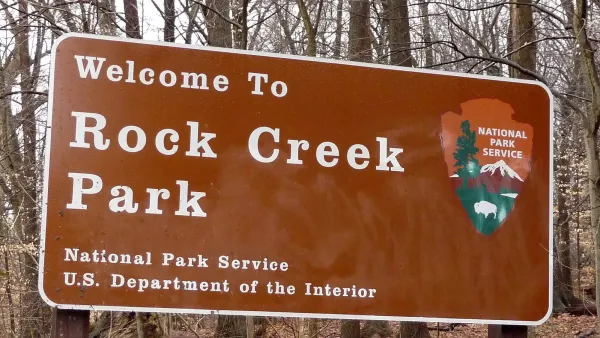
National Park Service Weighs Changes to D.C.’s Beach Drive
The scenic road has been closed to car traffic during the pandemic, but the park service could begin allowing through traffic nine months of the year.

D.C. Tops the 2021 ParkScore List
The Trust for Public Land has published the most recent version of its annual ranking of parks and open space. A new twist for 2021includes a new metric to consider equity.
An Interview With New York Parks Commissioner Mitchell Silver, FAICP
Mitchell Silver, commissioner of the New York City Department of Parks and Recreation, former planning director of Raleigh, and former president of the APA, discusses the aspirations and realities of a long, successful career in planning.

Planetizen Federal Action Tracker
A weekly monitor of how Trump’s orders and actions are impacting planners and planning in America.

California plans to bury El Niño’s downpour
If the state plays its cards right, it may be able to store a billion acre-feet of El Niño’s water in aquifers.

Desperate measures: Advocates weigh draining Lake Powell to fill Colorado River
Draining the reservoir could reduce evaporation losses by a couple hundred thousand acre-feet.

In Texas, data centers are swallowing promised parkland
Residents who moved to Taylor, Texas for a rural community now have to contend with three data centers in their backyard.

How a Chicago-sized wind farm beat the odds and powered on
The project spanned five presidential administrations and a standoff with a U.S. military base.

MTA gives itself 30 days to transform pit into basketball court
The site has been under construction since 2022; the city originally estimated it would finish the court in 2024.

FREE Course: Walkable City 1: Why Walkability?
After describing his path towards focusing on walkability as the essence of good planning, Jeff Speck marches through his five principal reasons for making more walkable places.
Reinventing Malls: Planning Alchemy—Turning Gray Fields Into Gold
The course focuses on the opportunities and imperatives that shape reinvention of mall sites.

City of Rosemead
Rutgers University, Edward J. Bloustein School of Planning and Public Policy
One Hundred Miles
Hunter College, City University of New York (CUNY)
The Architects Foundation
University of Cincinnati Online
City of Cambridge
Montrose County
The Pocatello Development Authority