Chicago has set lofty goals to become a leader in the next-generation technology and infrastructure of the global future.


"Mayor Rahm Emanuel today announced the launch of Current, a joint effort that brings together public and private partners from across the Chicago area, to solve the toughest water challenges facing the nation and the globe," according to a press release posted on the World Business Chicago Website.
" The effort will be led by an unprecedented partnership between the City of Chicago, the Metropolitan Water Reclamation District of Greater Chicago (MWRD) and World Business Chicago (WBC) and is designed to leverage the strength of the Chicago region’s water industry to drive critical research forward and generate greater economic impact."
Jen Kinney picked up the news for Next City, noting that Chicago's water economy is the forth largest in the United States, "with water infrastructure and technology accounting for $14 billion of the gross regional product."
An official website also has more information about the Current initiative.
Read the full story: Mayor Emanuel and Regional Partners Launch Joint Effort to Address International Water Challenges

Replacing lead pipes in Chicago costs more than 6 times the national average — and authorities can't explain why
Replacing one lead pipe in Chicago costs around $31,000, while the national average cost sits at around $4,700 per line.
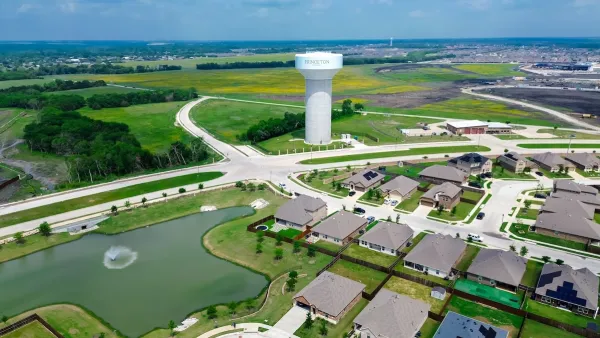
A 'Grim Diagnosis': Houston's Suburbs are Running out of Water
Rapidly growing cities are struggling to build out water infrastructure to meet the needs of new residents.

Illinois Legislators Pass Controversial I-55 Road Expansion Legislation
Legislation to enable the addition of express toll lanes on Interstate 55 in the Southwest Side of Chicago, opposed by environmental justice advocates, cleared the Illinois General Assembly last month.

Planetizen Federal Action Tracker
A weekly monitor of how Trump’s orders and actions are impacting planners and planning in America.

California plans to bury El Niño’s downpour
If the state plays its cards right, it may be able to store a billion acre-feet of El Niño’s water in aquifers.

Desperate measures: Advocates weigh draining Lake Powell to fill Colorado River
Draining the reservoir could reduce evaporation losses by a couple hundred thousand acre-feet.

Mamdani’s pied-à-terre tax survives legal challenge
A panel of judges found that the plaintiffs failed to demonstrate injury as a result of New York City's implementation of the tax.

Eastern Nebraska is running out of electricity
Data centers and electrification are straining eastern Nebraska’s grid, throttling economic development.

Seattle passes record-breaking transit services expansion
Proposition 1 will double the city’s transit tax to add 95,000 more bus trips and preserve 180,000 bus trips annually.

FREE Course: Walkable City 1: Why Walkability?
After describing his path towards focusing on walkability as the essence of good planning, Jeff Speck marches through his five principal reasons for making more walkable places.
Reinventing Malls: Planning Alchemy—Turning Gray Fields Into Gold
The course focuses on the opportunities and imperatives that shape reinvention of mall sites.

City of Rosemead
Rutgers University, Edward J. Bloustein School of Planning and Public Policy
One Hundred Miles
University of Michigan School for Environment and Sustainability (SEAS)
Hunter College, City University of New York (CUNY)
The Architects Foundation
City of Cambridge
Montrose County
The Pocatello Development Authority