Last Week Tonight with John Oliver tackles the corruption and mismanagement of special districts, which are well known to professional planners, but perhaps not to the rest of the general public.


According to the latest episode of Last Week Tonight with John Oliver, there are some 40,000 special districts in the country, spending a total of $100 billion a year.
To Oliver, that those numbers might comes as a surprise to many Americans. In fact: "You may not even know how many districts you are living in right now." Also, Oliver says, "Think of a special district like a cult. It can take your money, and you may not even be aware that you're in one."
To illustrate the strange world of special districts, Oliver gives the Mosquito Control District in the Town of Litchfield, New Hampshire major respect for running their meetings so scrupulously despite a lack of public attention to the proceedings. The Isaacson Municipal Utility District, on the other hand, gets major ignominy for faulty accounting, as does the Garrett Volunteer Fire Department in Floyd County, Kentucky, for spending taxpayer money on fireworks.
Oliver has more examples, all of which show his rare ability to make jokes out of wonky, and depressing topics.
Read the full story: Last Week Tonight with John Oliver: Special Districts (HBO)

Friday Funny: Squirrelly Passenger Causes UK Train Cancellation
Planetizen’s Friday Funny stories are often satirical, but this nutty story from Reuters is 100 percent genuine.
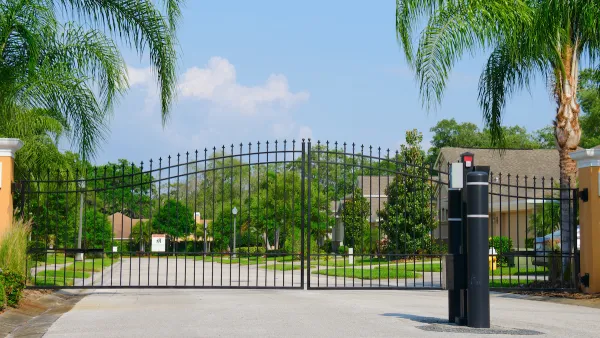
Friday Funny: Gated Community Doubles Down
The Onion skewers suburbia.

Friday Funny: How Much Parking Does That Parking Spot Need?
The Onion takes parking requirements to their logical conclusion.

Planetizen Federal Action Tracker
A weekly monitor of how Trump’s orders and actions are impacting planners and planning in America.

Washington state to charge fee to drivers with fuel-efficient cars
Revenue from the fee will go towards supporting the state’s highways.

Illinois considers spending $1 billion in taxpayer money on data center
A quantum computing campus and data center are currently under construction in Chicago.

Senate passes bill overhauling permitting
The bill still needs to pass the House.

Did data centers change how voters cast their ballots?
Texas, Ohio, and Georgia all flipped party control. But in rural counties, the effect of local data centers was mixed.

Amtrak invests in eight new Airo trainsets
The new trainsets will begin serving passengers in 2031.

FREE Course: Walkable City 1: Why Walkability?
After describing his path towards focusing on walkability as the essence of good planning, Jeff Speck marches through his five principal reasons for making more walkable places.
Reinventing Malls: Planning Alchemy—Turning Gray Fields Into Gold
The course focuses on the opportunities and imperatives that shape reinvention of mall sites.

City of Charlotte
City of Rosemead
Rutgers University, Edward J. Bloustein School of Planning and Public Policy
University of Michigan School for Environment and Sustainability (SEAS)
Hunter College, City University of New York (CUNY)
The Architects Foundation
University District Partnership