According to preliminary estimates from the National Safety Council, 38,300 people were killed on U.S. roads in 2015, an 8 percent jump from 2014. In fact, the annual increase is the most in half a century. Note that the figure differs from NHTSA's.


In addition to a record increase in fatalities, 4.4 million were seriously injured on U.S. roads, states the press release, making "2015 likely the deadliest driving year since 2008."
The estimate is subject to slight increases or decreases as data mature. National Safety Council (NSC) has issued annual traffic fatality estimates since 1921. Over the last three years, preliminary estimates have fallen within 1% of final counts.
"The National Safety Council uses National Center for Health Statistics data from the Centers for Disease Control and Prevention (CDC) because it includes fatalities that occur on non-public roads, whereas the National Highway Traffic Safety Administration [(NHTSA) a division of the U.S. Department of Transportation] data includes only fatalities on public roads," stated Ken Kolosh, manager of statistics at NSC, in an email.
"In addition CDC counts deaths that occur within 12 months of the crash while NHTSA's cutoff is 30 days," stated Kolosh. "We want to include the most accurate and comprehensive data as possible in our estimate."
According to NHTSA estimates, traffic deaths "show a steep 9.3 percent increase for the first nine months of 2015." [Also posted here.] NHTSA has yet to issue its complete 2015 report.
Different starting point for NHTSA and NSC
"NHTSA’s Fatal Analysis Reporting System (FARS) figures for 2014 show 32,675 people died in motor vehicle crashes in 2014, a 0.1-percent decrease from the previous year," states their November 24, 2015 press release. "An additional 2.3 million people were injured in crashes in 2014," notes the 2014 Crash Data Key Findings [PDF].
NSC reported that traffic fatalities totaled 35,398 for 2014, "a less than 0.5% increase from 2013," in their supplemental estimate information [PDF]. Injuries also will likely show a major gap. "The National Safety Council defines 'serious injuries' as those requiring medical attention," notes their press release, which may explain the large figure (4.4 million) compared with NHTSA's 9-month figure of 2.3 million people
Finally, an appropriate reminder from Deborah A.P. Hersman, NSC president and CEO. "Driving a car is one of the riskiest activities any of us undertake in spite of decades of vehicle design improvements and traffic safety advancements."
Read the full story: Motor Vehicle Deaths Increase by Largest Percent in 50 Years
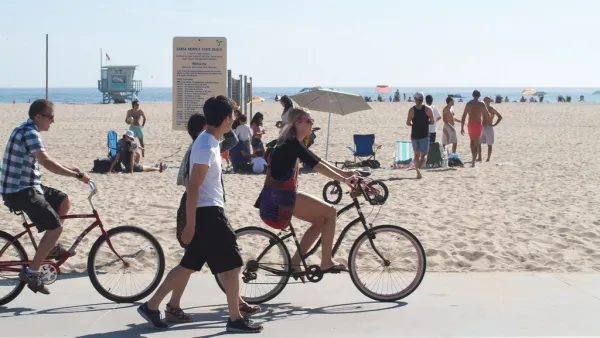
The Critical Importance of Bicycle Infrastructure to Public Health
The lead editorial in the December issue of American Journal of Public Health provides the introduction for two research papers on the relationship between bicycling safety and infrastructure expansion in Boston and Vision Zero in U.S. and Sweden.

New Study Reveals Causes of Lower American Life Expectancy
A study published February 9 in the Journal of the American Medical Association points to three reasons for the life expectancy being lower for Americans than in other developed nations. Care to guess what they are?
Living (and Dying) with COVID: How Many Deaths are Acceptable?
Political analyst Philip Bump asks the "unstated, unpleasant question" that the U.S. has struggled with since the inception of the pandemic, more relevant now with the widespread availability of vaccines that are effective at preventing most deaths.

Planetizen Federal Action Tracker
A weekly monitor of how Trump’s orders and actions are impacting planners and planning in America.

California plans to bury El Niño’s downpour
If the state plays its cards right, it may be able to store a billion acre-feet of El Niño’s water in aquifers.

Desperate measures: Advocates weigh draining Lake Powell to fill Colorado River
Draining the reservoir could reduce evaporation losses by a couple hundred thousand acre-feet.

In Texas, data centers are swallowing promised parkland
Residents who moved to Taylor, Texas for a rural community now have to contend with three data centers in their backyard.

How a Chicago-sized wind farm beat the odds and powered on
The project spanned five presidential administrations and a standoff with a U.S. military base.

MTA gives itself 30 days to transform pit into basketball court
The site has been under construction since 2022; the city originally estimated it would finish the court in 2024.

FREE Course: Walkable City 1: Why Walkability?
After describing his path towards focusing on walkability as the essence of good planning, Jeff Speck marches through his five principal reasons for making more walkable places.
Reinventing Malls: Planning Alchemy—Turning Gray Fields Into Gold
The course focuses on the opportunities and imperatives that shape reinvention of mall sites.

City of Rosemead
Rutgers University, Edward J. Bloustein School of Planning and Public Policy
One Hundred Miles
Hunter College, City University of New York (CUNY)
The Architects Foundation
University of Cincinnati Online
City of Cambridge
Montrose County
The Pocatello Development Authority