One of the more lively parts of Saturday night's Republican debate were the interactions between candidates Donald Trump, Jeb Bush, and the audience who booed Trump. But it hid a more serious matter—the use of eminent domain for the Northern Pass.


According to the project overview, "Northern Pass is a 192-mile transmission line project that will bring 1,090 megawatts (MW) of clean, affordable energy from Hydro-Québec’s world-class hydroelectric plants in Canada to New Hampshire and to the rest of New England." StateImpact calls it "a highly controversial proposal." Opponents have unwisely been labeled "NIMBYs", according to a 2014 Planetizen post.
Trump was asked by WMUR-TV anchor Josh McElveen, one of ABC's moderators during the debate, "Do you see eminent domain as an appropriate tool to get that done?"
However, while the future of the project is unsettled, the use of eminent domain was taken off the table by the legislature. "In 2012, former governor John Lynch (D) signed a law blocking utility companies from using eminent domain for certain projects, a law aimed at the contentious Northern Pass project, which seeks to string power lines from Quebec through New Hampshire, connecting a Canadian hydroelectric plant to New England’s power grid," reported the Washington Post on Jan. 26.
Bush and Trump also debated the use of eminent domain in the Keystone XL pipeline.
TRUMP to Bush: Eminent domain, the Keystone pipeline — do you consider that a private job?
BUSH: I consider it a public use.
The two go back and forth on that. Actually, it's a private job for what can be viewed as a public use, i.e., they were both right.
Notwithstanding the serious nature of eminent domain, the Northern Pass, and Keystone XL, the exchange was rather comical, with Trump telling Bush to be "quiet" numerous times, that he was trying to be a "tough guy," with Bush responding, "How tough it is to take away property from an elderly woman?" referring to Trump's use of eminent domain in his role as a developer in Atlantic City, N.J. in the 1990s (posted here).
And when the audience booed Trump for being a bully, he pounced on them, accusing them of being "all of (Bush's) donors and special interests out there."
Read the full story: NH #GOPdebate audience boos Donald Trump after he orders Jeb Bush to be quiet
Eminent Domain an Issue in Republican Presidential Primary, Again
Sen. Ted Cruz (R-Texas) is using a new ad against GOP frontrunner Donald Trump, a billionaire real estate developer, based on his use of eminent domain against an elderly woman in Atlantic City. Trump strongly defended using the controversial tool.
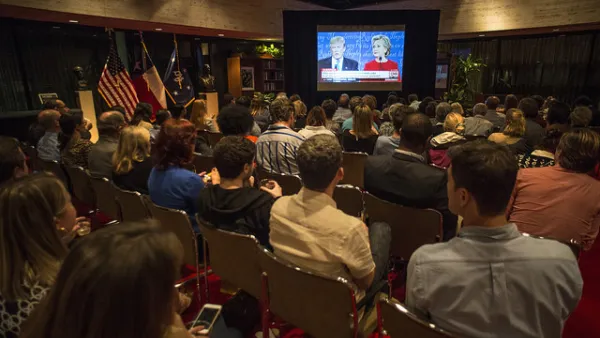
Trump: The Ultimate Unintended Consequence
In Sacramento, a protracted fight involving the California Environmental Quality Act downsized a proposed development. It also added fuel to the pro-Trump, anti-development fire that swept the nation on November 8.
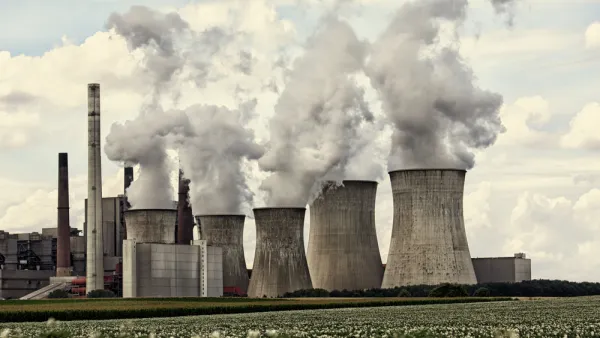
Getting it Right on U.S Energy Independence
During the second presidential debate Democratic candidate Hillary Clinton claimed that the "U.S. was energy independent." Some in the media, including Politifact, were quick to report that claim as "false." And the news just got worse.

Planetizen Federal Action Tracker
A weekly monitor of how Trump’s orders and actions are impacting planners and planning in America.

California plans to bury El Niño’s downpour
If the state plays its cards right, it may be able to store a billion acre-feet of El Niño’s water in aquifers.

Desperate measures: Advocates weigh draining Lake Powell to fill Colorado River
Draining the reservoir could reduce evaporation losses by a couple hundred thousand acre-feet.

US buildings threatened, destroyed by fires set to triple by 2060
Researchers found a high fire risk for socioeconomically vulnerable neighborhoods in the American West.

LA residents may be allowed to paint their own crosswalks
Councilwoman Katy Yaroslavsky put out a motion instructing the Los Angeles Department of Public Transportation to study the feasibility of allowing volunteers to paint crosswalks.

Dallas moves to overhaul its zoning code
The city's zoning reform will allow more multi-family and mixed-use developments.

FREE Course: Walkable City 1: Why Walkability?
After describing his path towards focusing on walkability as the essence of good planning, Jeff Speck marches through his five principal reasons for making more walkable places.
Reinventing Malls: Planning Alchemy—Turning Gray Fields Into Gold
The course focuses on the opportunities and imperatives that shape reinvention of mall sites.

City of Rosemead
Rutgers University, Edward J. Bloustein School of Planning and Public Policy
One Hundred Miles
Hunter College, City University of New York (CUNY)
The Architects Foundation
University of Cincinnati Online
City of Cambridge
Montrose County
The Pocatello Development Authority