One of the sad contradictions of the revival of core urban areas has been the clash between waves of investment and affluence with large populations of homelessness. Many cities are still coming to terms with the issue, much less solving it.


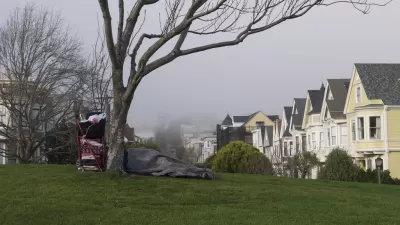
"As once derelict or sleepy downtown districts in U.S. cities evolve into thriving hot spots, officials are grappling with what to do about homeless populations that have long inhabited them," according to an article by Arian Campo-Flores, Cameron McWhirter and Alejandro Lazo.
The article also notes that thought he number of homeless people around the country is declining overall, several cities, including New York, Los Angeles, San Francisco, Miami, and Seattle, the number is increasingly. "In New York, the homeless population increased nearly 42% to 75,323 from 53,187," for instance.
As planners know, redevelopment exacerbates the homelessness issue in more ways that one: "While city officials, who often support redevelopment, face added pressure from new residents to address homelessness, advocates for the unsheltered say the response too often is to try to remove them from sight without providing adequate support."
Besides those most famous of U.S. cities listed above, the article also spends some time in Tulsa, where downtown revitalization has meant that the city's homeless population is "no longer out of site out of mind."
FULL STORY: Thriving U.S. Cities Grapple With Homelessness Surge

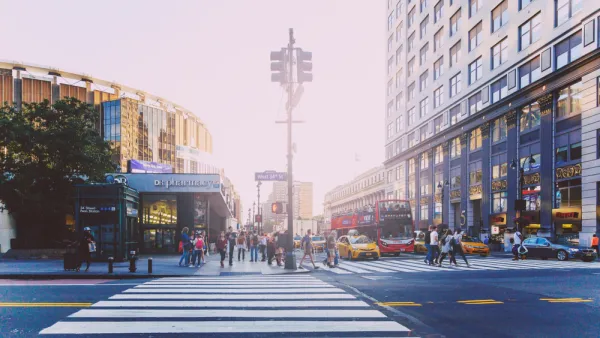
Massive Empire State Complex Gains Key Political Support
New York Governor Kathy Hochul is backing one of the largest real estate development projects in U.S. history—larger even than the nearby Hudson Yards project.
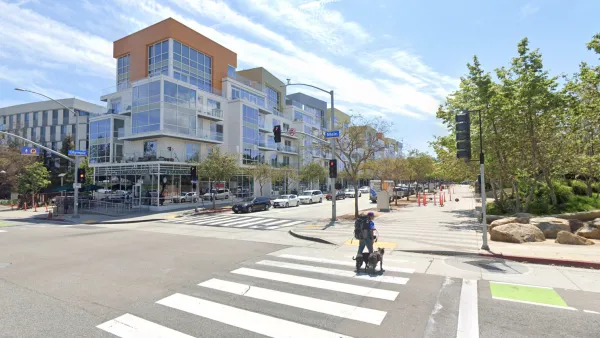
Seasoned Developer Opines on California’s Housing Crisis
Bill Witte, CEO and chairman of Related California, discusses how state and local governments ought to respond to the state’s challenges with housing affordability, growth in homelessness, and 'missing middle' housing supply.
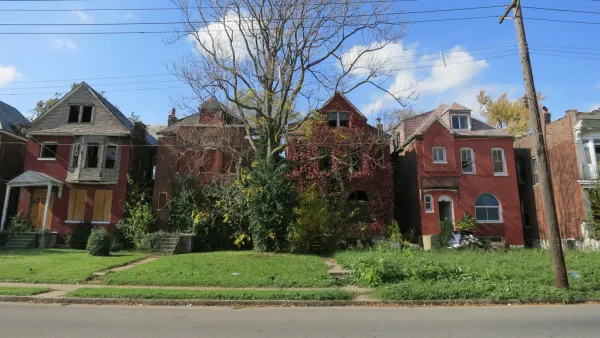
The Dark Side of the Rust Belt Revival
Cities in flyover country are facing new redevelopment challenges as companies relocate from costly coastal cities. In St. Louis, downtown revitalization has also brought plans to tackle blight, and the consequences for residents could be immense.

Planetizen Federal Action Tracker
A weekly monitor of how Trump’s orders and actions are impacting planners and planning in America.

The state-sanctioned urbicide of Austin
People don’t kill cities. Freeways do.

US to reduce Colorado River water deliveries to Mexico
A new Colorado Treaty amendment reduces Mexico’s Colorado River water allocation by 250,000 acre feet.

5 New England states march closer to 800 megawatt wind energy project
Securing federal approval for the project may be complicated under the Trump administration, which has historically been hostile towards domestic wind power.

Baltimore to break ground on $50 million Transit Priority Project
The project will bring faster bus trips, safer streets and better bike connections to Baltimore.

Airbnb launches $250 million 'last-dollar financing' housing accelerator, makes first investment in Austin
The company will put $6.4 million towards affordable housing development in Texas’ capital.

FREE Course: Walkable City 1: Why Walkability?
After describing his path towards focusing on walkability as the essence of good planning, Jeff Speck marches through his five principal reasons for making more walkable places.
Reinventing Malls: Planning Alchemy—Turning Gray Fields Into Gold
The course focuses on the opportunities and imperatives that shape reinvention of mall sites.

Eagle County Government
Harvard University Graduate School of Design
Nashville Planning Department
The Architects Foundation
University of Cincinnati Online
The Pocatello Development Authority
The Urban Renewal Agency of the City of Pocatello
Journal of the American Planning Association