Portland, Oregon Transportation Director Leah Treat quietly enacted one of the nation's most pro-bike policies last fall.


Michael Andersen writes of a policy enacted in Portland, Oregon last fall, which adopts one of the most supportive bureaucratic requirements for bike infrastructure in the country. "Effective immediately, every time Portland road designers recommended a bike lane, they would need to make it a protected bike lane — or else explain why not," explains Andersen.
"Portland's policy, announced internally in an Oct. 19 memo from Transportation Director Leah Treat, applies to all city-managed streets with average daily traffic of 3,000 motor vehicles or more," adds Andersen.
According to Andersen, Treat is on the record saying the city will go even further than the terms laid out by this internal direction to staff. "The city is also preparing to consider a formal administrative rule that she said would require developers to provide protected bike lanes with new developments — much as they've long been required to provide sidewalks."
The article includes more detail on the thinking behind the policy, and Treat's goals for the city in enacting the policy.
Read the full story: PORTLAND IS FIRST U.S. CITY TO MAKE PROTECTION THE DEFAULT FOR ALL NEW BIKE LANES

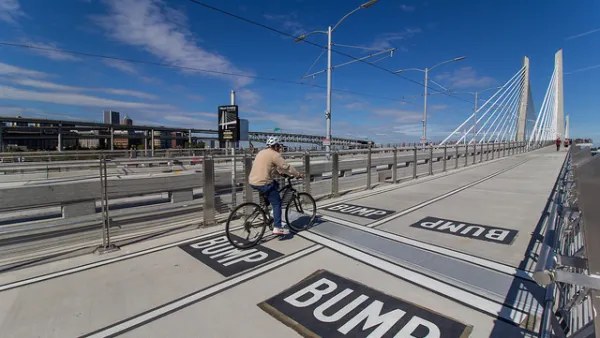
Portland and Multnomah County Push for Lower Speed Limits on Bridges
The Portland Bureau of Transportation and Multnomah County agree on a 30 mph speed limit on five downtown bridges, but the state's department of transportation denied the change on two key spans.
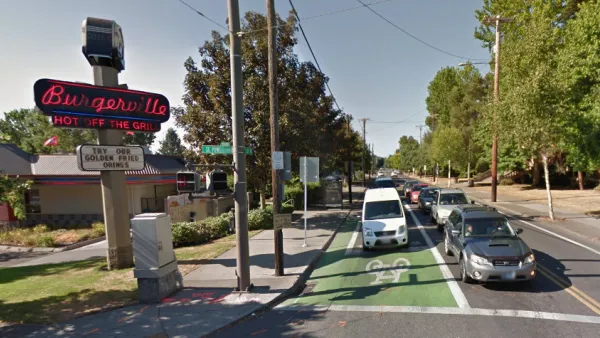
Making Protected Bike Lanes the Design Standard
An institutional mandate isn't enough to make a design vision a reality. Portland is working on bringing its standards and guidelines in line with its ambition for protected bike lanes.
Portland Bike Lanes and the Danger of Half-Measures
Willamette's new bike lanes make for an important link in Portland's bike infrastructure, but building unprotected bike lanes on a high-speed street carries risk.

Planetizen Federal Action Tracker
A weekly monitor of how Trump’s orders and actions are impacting planners and planning in America.

The state-sanctioned urbicide of Austin
People don’t kill cities. Freeways do.

US to reduce Colorado River water deliveries to Mexico
A new Colorado Treaty amendment reduces Mexico’s Colorado River water allocation by 250,000 acre feet.

Nation's most wind-powered state turns to coal as data centers increase energy demand
For the first time in decades, Iowa has increased its generation of coal power.

NYC cools commuters with city's first rain garden above a bus stop
New York City officials say the plants in the rain garden can absorb 16 gallons of rainwater during heavy storms.

Brightline West’s future may rely on $6 billion federal loan
The company has until Nov. 2 to make a $400 million equity investment into its proposed high-speed rail line.

FREE Course: Walkable City 1: Why Walkability?
After describing his path towards focusing on walkability as the essence of good planning, Jeff Speck marches through his five principal reasons for making more walkable places.
Reinventing Malls: Planning Alchemy—Turning Gray Fields Into Gold
The course focuses on the opportunities and imperatives that shape reinvention of mall sites.

Eagle County Government
Harvard University Graduate School of Design
Nashville Planning Department
The Architects Foundation
University of Cincinnati Online
The Pocatello Development Authority
The Urban Renewal Agency of the City of Pocatello
Journal of the American Planning Association