The long-delayed First Hill streetcar offered its first trips to the public last weekend in Seattle. Big questions about the operation and effectiveness of the streetcar still remain.


"Seattle’s long-awaited First Hill Streetcar, proposed a decade ago, will finally carry passengers Saturday in a casual 'soft launch' featuring free rides," reports Mike Lindblom. "A grand-opening ceremony, to include performances and neighborhood festivals, will be announced later."
Lindblom details the planning case made for the long-delayed First Hill line, including ongoing questions "about whether Sound Transit compromised its state mandate to supply 'high capacity transit,' which runs chiefly in its own right of way." The First Hill line will travel in mixed traffic with cars, with an 18-minute travel time from end to end. According to Lindblom, "Agency leaders have replied that the streetcar will support its huge light-rail system by feeding passengers to two stations. The line connects the future Capitol Hill light-rail station to the International District/Chinatown Station, passing through Broadway, South Jackson Street and reaching Pioneer Square."
The article includes a lot more about the many question marks that led to this weekend's soft opening, and the many questions that still remain to be answered in the early weeks of the system's operations.
In a separate article, Gordon Werner reports on the announcement of the soft opening and provides operating hours and frequencies.
Read the full story: Seattle’s First Hill Streetcar to open Saturday with free rides
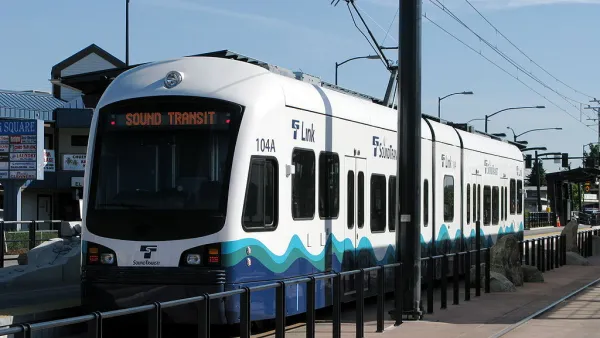
Sound Transit Reveals Early 2024 Service Plans
Seattle’s transit agency is looking to maximize its limited resources as it continues to grapple with staffing shortages and supply chain issues across the region.
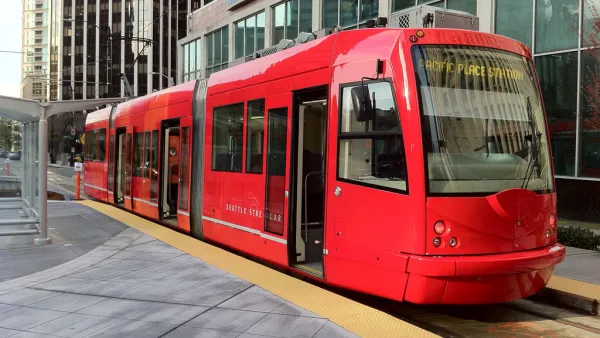
Central City Connector Streetcar Inches Forward in Seattle
In the first signs of life for the beleaguered transit project in over a year, Seattle officials found some of the money they need to proceed with the Central City Connector streetcar project.
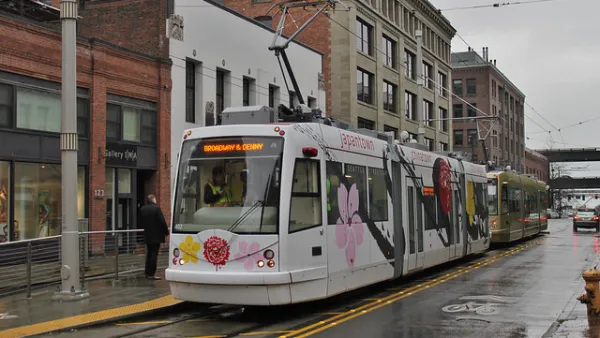
Seattle Exploring News Ways to Give Traffic Priority to Streetcars
Short of running the First Hill Streetcar on it's own dedicated right of way, the Seattle Department of Transportation has a few ideas for how to speed up service.

Planetizen Federal Action Tracker
A weekly monitor of how Trump’s orders and actions are impacting planners and planning in America.

California plans to bury El Niño’s downpour
If the state plays its cards right, it may be able to store a billion acre-feet of El Niño’s water in aquifers.

Desperate measures: Advocates weigh draining Lake Powell to fill Colorado River
Draining the reservoir could reduce evaporation losses by a couple hundred thousand acre-feet.

US buildings threatened, destroyed by fires set to triple by 2060
Researchers found a high fire risk for socioeconomically vulnerable neighborhoods in the American West.

LA residents may be allowed to paint their own crosswalks
Councilwoman Katy Yaroslavsky put out a motion instructing the Los Angeles Department of Public Transportation to study the feasibility of allowing volunteers to paint crosswalks.

Dallas moves to overhaul its zoning code
The city's zoning reform will allow more multi-family and mixed-use developments.

FREE Course: Walkable City 1: Why Walkability?
After describing his path towards focusing on walkability as the essence of good planning, Jeff Speck marches through his five principal reasons for making more walkable places.
Reinventing Malls: Planning Alchemy—Turning Gray Fields Into Gold
The course focuses on the opportunities and imperatives that shape reinvention of mall sites.

City of Rosemead
Rutgers University, Edward J. Bloustein School of Planning and Public Policy
One Hundred Miles
Hunter College, City University of New York (CUNY)
The Architects Foundation
University of Cincinnati Online
City of Cambridge
Montrose County
The Pocatello Development Authority