Cars and cyclists have issues at intersections. A new type of intersection design from the Netherlands offers improved protection to cyclists. The solution is based on the four islands near each corner of the intersection.


"The so-called Dutch junction offers protection to cyclists at intersections, regardless of whether they’re turning left, turning right, or continuing straight. The key to its design are the four islands near each corner of the intersection. They prevent cars from entering the pathway of cyclists turning right. Meanwhile, they force cyclists traveling straight to move into the view of automobiles and out of their blind spots," according to an article by Ryan Holleywell.
Davis, California, became the first city to implement the Dutch junction in August. Salt Lake City followed with its own protected intersection (as they're also known) in October. "Fifty years ago, the city debuted the country’s first bike lane. Today, Davis is striving to achieve 30 percent bicycle ridership by 2020." Other cities in the U.S. such as Austin, Boston, and Salt Lake City are also looking at the junction design for their bike lanes.
FULL STORY: They've Invented An Ingenious New Type Of Intersection That Could Save Lives

America's Second Protected Intersection Now Open
The first protected intersection opened in August in Davis, Calif., a university town with the nation's highest percentage of bike commuters. Salt Lake City's new protected intersection is explained on NPR's "Here & Now" report with audio and videos.
The Protected Intersection for Bicycles Has Arrived
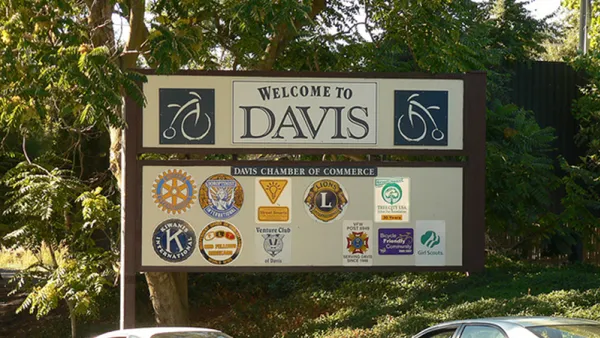
The city of Davis, California, a college town with extremely high commute mode share for bikes, made history last week as the first U.S. city to build a protected intersection for bikes.
Demystifying the Turning Radius and its Critical Importance to Street Safety
A MinnPost article explains the importance of a properly tuned turning radius while getting to the bottom of a controversial decision to remove pedestrian and bike infrastructure.

Planetizen Federal Action Tracker
A weekly monitor of how Trump’s orders and actions are impacting planners and planning in America.

The state-sanctioned urbicide of Austin
People don’t kill cities. Freeways do.

US to reduce Colorado River water deliveries to Mexico
A new Colorado Treaty amendment reduces Mexico’s Colorado River water allocation by 250,000 acre feet.

5 New England states march closer to 800 megawatt wind energy project
Securing federal approval for the project may be complicated under the Trump administration, which has historically been hostile towards domestic wind power.

Baltimore to break ground on $50 million Transit Priority Project
The project will bring faster bus trips, safer streets and better bike connections to Baltimore.

Airbnb launches $250 million 'last-dollar financing' housing accelerator, makes first investment in Austin
The company will put $6.4 million towards affordable housing development in Texas’ capital.

FREE Course: Walkable City 1: Why Walkability?
After describing his path towards focusing on walkability as the essence of good planning, Jeff Speck marches through his five principal reasons for making more walkable places.
Reinventing Malls: Planning Alchemy—Turning Gray Fields Into Gold
The course focuses on the opportunities and imperatives that shape reinvention of mall sites.

Eagle County Government
Harvard University Graduate School of Design
Nashville Planning Department
The Architects Foundation
University of Cincinnati Online
The Pocatello Development Authority
The Urban Renewal Agency of the City of Pocatello
Journal of the American Planning Association