One writer's view of the modern city goes negative. If our environment affects our happiness, surely we're all suffering from depression.


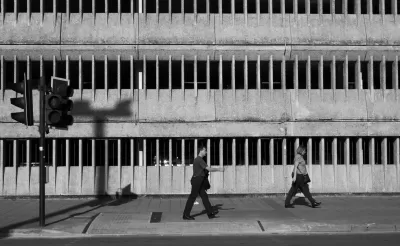
Architect Bill Beard gives his critique of America’s miserable built environment in an essay on AdBusters. Pulling few punches, Beard offers a scathing assessment of our "flat, dystopian landscape," which at best is a succubus on our creative spirits.
Our common daily experience in the modern American anywhere is anything but robust. We live in un-places, built of cheap materials, ignorant of scale and proportion, executed with little care, imbued with no trace of the human hand and lacking in a sense of context - which can only create humans of similar character. That is to say that humans implicitly absorb the character of their surroundings. Ugly, thoughtless, depressing surroundings do not encourage beautiful, creative, vigorous people - people with soul and spirit.
The take-away from Beard's assessment is that we're doomed if we do nothing to fix things. The impacts on our health and well-being might not be visible in the short term, but this "ailing built environment condition" will irreparably harm our society in the not so distant future.
FULL STORY: The modern built environment

Only one US city makes the Happy City Index top 50
The list is topped by Copenhagen, Helsinki, and Geneva.

How the Built Environment Affects Your Mood
Humans have survived for millennia by staying together, not apart.

As Canadian Cities Grow, Survey Finds Happiest Canadians are in Smaller Communities
The happiest people in Canada, according to a survey of life satisfaction, tend to live in significantly less dense communities than the least happy.

Planetizen Federal Action Tracker
A weekly monitor of how Trump’s orders and actions are impacting planners and planning in America.

The state-sanctioned urbicide of Austin
People don’t kill cities. Freeways do.

US to reduce Colorado River water deliveries to Mexico
A new Colorado Treaty amendment reduces Mexico’s Colorado River water allocation by 250,000 acre feet.

5 New England states march closer to 800 megawatt wind energy project
Securing federal approval for the project may be complicated under the Trump administration, which has historically been hostile towards domestic wind power.

Baltimore to break ground on $50 million Transit Priority Project
The project will bring faster bus trips, safer streets and better bike connections to Baltimore.

Airbnb launches $250 million 'last-dollar financing' housing accelerator, makes first investment in Austin
The company will put $6.4 million towards affordable housing development in Texas’ capital.

FREE Course: Walkable City 1: Why Walkability?
After describing his path towards focusing on walkability as the essence of good planning, Jeff Speck marches through his five principal reasons for making more walkable places.
Reinventing Malls: Planning Alchemy—Turning Gray Fields Into Gold
The course focuses on the opportunities and imperatives that shape reinvention of mall sites.

Eagle County Government
Harvard University Graduate School of Design
Nashville Planning Department
The Architects Foundation
University of Cincinnati Online
The Pocatello Development Authority
The Urban Renewal Agency of the City of Pocatello
Journal of the American Planning Association