Journalist Alex Ulam speaks with Sarene Marshall, director of the Urban Land Institute's Center for Sustainability, about the role conservation is playing in fighting climate change and her role at the agency.


What was it like moving from The Nature Conservancy to the Urban Land Institute? They seem like very different organizations. For one thing, one focuses on wild areas and the other focuses on settled areas.
When I worked at The Nature Conservancy, a dramatic transformation was taking place in conservation everywhere. We were shifting from this older notion of parks and protected areas, places that we put fences around and kept people out of, to one where people are going to be part of conservation landscapes.
Increasingly, there are fewer and fewer places in the world that you can imagine being completely pristine. So at The Nature Conservancy our work changed significantly, from being wholly focused on protecting wild places to also working on conservation issues involving land that was ranched or farmed or timbered. We were also engaging urban populations about where their water and food is coming from.
Read the full story: A conservationist turns to the city
Could the Humble Heat Pump Be a Decarbonization Hero?
Buildings are responsible for a little less than half of greenhouse gas emissions in the U.S. Break this figure down further and you'll find that building heating accounts for about a fifth of all U.S. emissions.
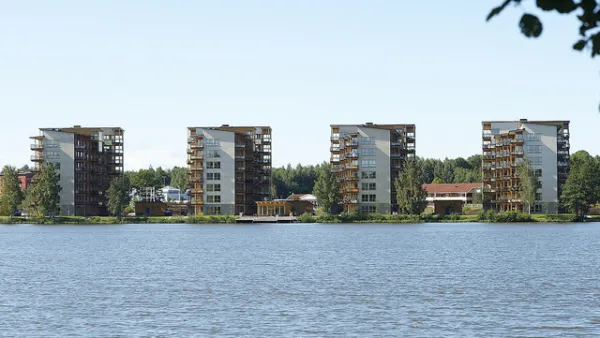
Fire Tests Enable New Timber Typologies
After a long time lost in the woods, architects and engineers are rediscovering timber. Recent fire tests have demonstrated that timber can be a viable building material and meet existing code requirements.
Can Insurance Markets Jump-Start Resilience?
Risk-management experts are seeking creative ways to finance resilience investments that prevent damage from natural disasters. Insurance markets, with their direct stake in protecting homes and businesses, can be key partners in this effort.

Planetizen Federal Action Tracker
A weekly monitor of how Trump’s orders and actions are impacting planners and planning in America.

California plans to bury El Niño’s downpour
If the state plays its cards right, it may be able to store a billion acre-feet of El Niño’s water in aquifers.

Desperate measures: Advocates weigh draining Lake Powell to fill Colorado River
Draining the reservoir could reduce evaporation losses by a couple hundred thousand acre-feet.

Mamdani’s pied-à-terre tax survives legal challenge
A panel of judges found that the plaintiffs failed to demonstrate injury as a result of New York City's implementation of the tax.

Eastern Nebraska is running out of electricity
Data centers and electrification are straining eastern Nebraska’s grid, throttling economic development.

Seattle passes record-breaking transit services expansion
Proposition 1 will double the city’s transit tax to add 95,000 more bus trips and preserve 180,000 bus trips annually.

FREE Course: Walkable City 1: Why Walkability?
After describing his path towards focusing on walkability as the essence of good planning, Jeff Speck marches through his five principal reasons for making more walkable places.
Reinventing Malls: Planning Alchemy—Turning Gray Fields Into Gold
The course focuses on the opportunities and imperatives that shape reinvention of mall sites.

City of Rosemead
Rutgers University, Edward J. Bloustein School of Planning and Public Policy
One Hundred Miles
University of Michigan School for Environment and Sustainability (SEAS)
Hunter College, City University of New York (CUNY)
The Architects Foundation
City of Cambridge
Montrose County
The Pocatello Development Authority