A public-private partnership could bring new development to some of the parking lots outside the home of the Texas Rangers. It's not the first grand plan to get floated for the ballpark's ancillary areas.


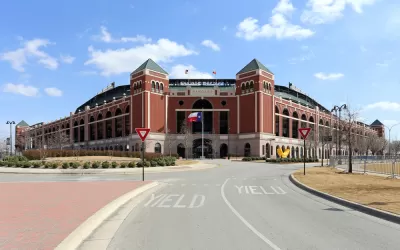
"The city of Arlington and Texas Rangers are considering collaborating on a $200 million mixed-use development near Globe Life Park," reports Claire Z. Cardona. As currently proposed, the project "would include about 100,000 square feet of restaurant, retail and entertainment space near the Rangers’ stadium," and "a hotel with at least 300 rooms and 35,000 square feet of meeting and convention space."
According to Cardona, the project would require a public-private partnership: "the city would give the Rangers performance-based incentives including income from property, sales, mixed beverage and hotel occupancy tax for 30 years, according to agenda notes. It also would include hotel occupancy and sales tax income from the state for 10 years."
The article neglects to notice a steady stream of media attention devoted to the possibility that the Rangers would move their home ballpark somewhere more urban—like somewhere in the city limits of Dallas. Possible reasons for the team's departure: poor attendance and a lease set to expire in 2024, according to a September editorial by the Fort Worth Star-Telegram.
Back to the development proposal, which would assume the team is staying put—Jeff Mosier followed up the announcement (and pretty renderings!) of the project with a brief history of failed development proposals for the land around the ballpark. The first plan failed in 1991, while a 2004 plan led the team's ownership at the time into bankruptcy.
Read the full story: Arlington considering $200 million proposed development near Rangers ballpark
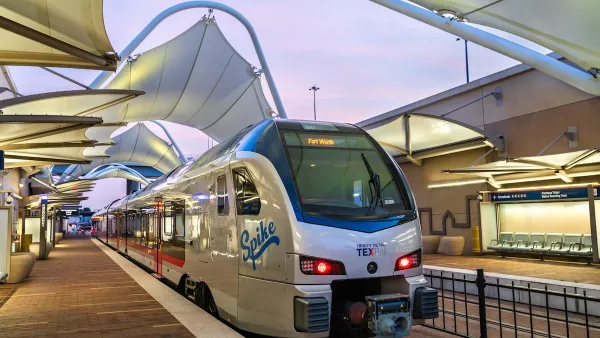
North Texas Transportation Council Advocates for Road Safety, Rail Projects
The North Texas Regional Transportation Council issued a series of recommendations for state legislators that include more support for road safety projects and high-speed rail.
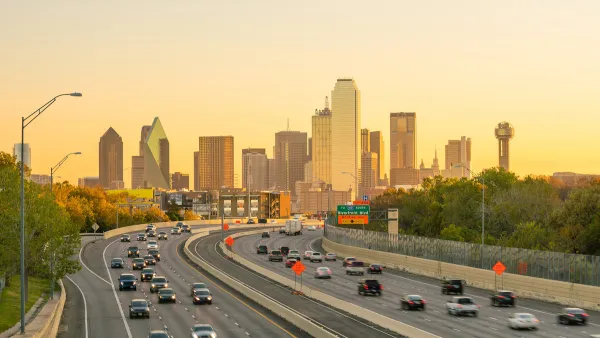
AI Traffic Management Comes to Dallas-Fort Worth
Several Texas cities are using an AI-powered platform called NoTraffic to help manage traffic signals to increase safety and improve traffic flow.
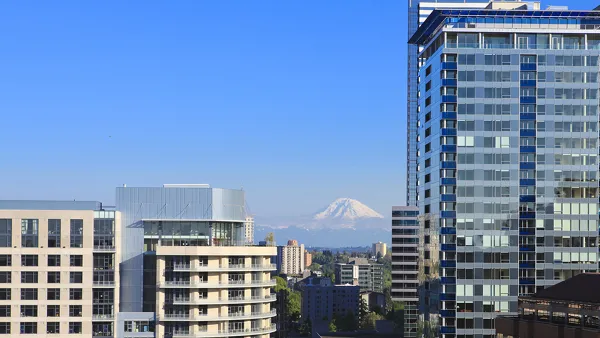
2020 Population Growth Rates for the 50 Biggest U.S. Cities
The Census Bureau released new data on May 27 that includes the first four months of the pandemic. Seattle tops the growth rate at 2.2% from July 1, 2019, to July 1, 2020, while Baltimore and San Francisco land at the bottom with -1.4%.

Planetizen Federal Action Tracker
A weekly monitor of how Trump’s orders and actions are impacting planners and planning in America.

Eastern Nebraska is running out of electricity
Data centers and electrification are straining eastern Nebraska’s grid, throttling economic development.

Study reveals best places in the U.S. for cycling, walking
New research from Streetlight Data examines bicycle and pedestrian miles per capita in the 100 largest U.S. cities by population.

Next-generation nuclear reactors are coming to Texas
The reactors will not require towering containment structures thanks to new safety features.

California distributes $1.3 billion to prevent transit service cuts, bolster projects
Twenty-eight projects across California received a portion of the funding.

Pennsylvania Democrats have 15 affordability, clean energy bills for flipped state Senate
Bills in consideration include a bill supporting geothermal energy and a bill supporting solar on warehouses.

FREE Course: Walkable City 1: Why Walkability?
After describing his path towards focusing on walkability as the essence of good planning, Jeff Speck marches through his five principal reasons for making more walkable places.
Reinventing Malls: Planning Alchemy—Turning Gray Fields Into Gold
The course focuses on the opportunities and imperatives that shape reinvention of mall sites.

City of Charlotte
City of Rosemead
Rutgers University, Edward J. Bloustein School of Planning and Public Policy
University of Michigan School for Environment and Sustainability (SEAS)
Hunter College, City University of New York (CUNY)
The Architects Foundation
City of Cambridge
The Pocatello Development Authority
The Urban Renewal Agency of the City of Pocatello