The strategy of Iowa's Department of Transportation chief, Paul Trombino III, for maintaining the state's "25,000 bridges, 114,000 miles of roadway, and more than 4,000 miles of rail" is not to do so. In a word, "shrinkage" is part of the solution.


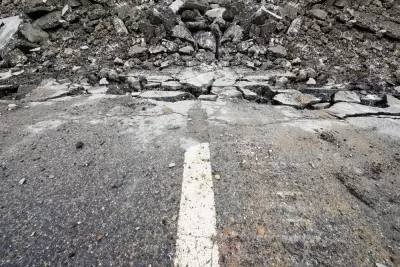
Shrinkage is by no means a new concept for Planetizen readers—it's been applied to cities like Detroit and Youngstown where the population has shrunk, leaving vacant housing that has become blighted.
It's time the term was applied to transportation as limited state budgets simply can not keep up with infrastructure demands, suggests Trombino III, who was elected as association president of the American Association of State Highway and Transportation (AASHTO) on September 28.
Trombino III "said it’s not affordable for the state to maintain Iowa’s current transportation system, and, furthermore, it’s not necessary to do so," writes Jill Kasparie, reporter for KCRG-TV9. [Video appears with article.]
The state is putting money into a focused number of projects instead of trying to fix up the entire outdated system.
At the end of the video, Kasparie is asked why the system should shrink after the legislature voted to increase the gas tax by 10-cents in February. She responds that critical roads do need improvement, but to maintain the entire system would be unaffordable, she responds.
Indeed, no one should get the idea that Iowa is pursuing a "shrink the transportation system" analogous to older cities treatment of vacant housing stock. As noted after the gas tax increase took effect on March 1, highway expansions are very much part of Iowa's transportation planning.
Trombino III's point is timely. Consider the November 23 release of "Unclogging America’s Arteries 2015: Prescriptions for Healthier Highways" that calls for 'unchoking the bottlenecks' and the anticipated finalization next week of the first six-year transportation reauthorization bill since 2005.
Federal transportation funding will not be increasing, and even for states that substantially increase transportation funding (gas tax increased over 44% in the Hawkeye State), "winnowing" needs to be considered if states want to pursue the 'improvements' suggest by the American Highway Users Alliance.
And not just for roads. Route Fifty calls attention to the "61,030 of 607,013 bridges (that) were deemed structurally deficient as of last year, according to figures in the 2015 edition of the Transportation Department's 'State Transportation Statistics' issued on Nov. 13."
Hat tip: AASHTO Daily Transportation Update.
Read the full story: Iowa DOT director says transportation system will shrink

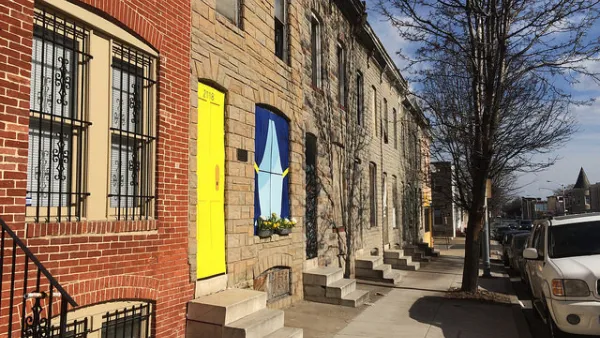
'Supporting Shrinkage': Lessons for U.S. Cities
An excerpt from "Supporting Shrinkage: Better Planning and Decision-Making for Legacy Cities," written by Michael P. Johnson, Justin B. Hollander, Eliza W. Kinsey, and George R. Chichirau and published by SUNY Press.
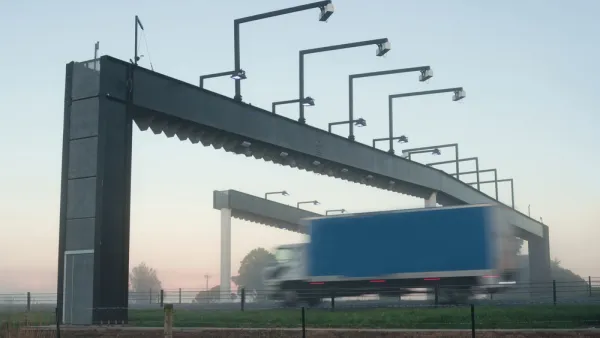
Nation's First Truck-Only Toll Program Off to Auspicious Start
After the Rhode Island General Assembly passed controversial legislation in February 2016 spearheaded by Gov. Gina Raimondo (D), the first two of what will be 13 truck-only toll gantries became operational on June 11. Results are looking good.
Increase Gas Tax—Fund Highway Expansions
While some states are cutting back on transportation expenditures as funds run short, Iowa is not one of them, having passed a 10-cent gas tax increase that took effect March 1. New highway expansions are funded in addition to "fix it first."

Planetizen Federal Action Tracker
A weekly monitor of how Trump’s orders and actions are impacting planners and planning in America.

Amtrak, CN end decades-long dispute with eight-year agreement
The new operating agreement establishes an updated framework for the companies to work together, including processes to resolve disputes.

Judges permit Denver to divert 77,000 acre feet from the Colorado River for reservoir expansion
Overuse and climate change have caused the Colorado River’s water levels to plummet.

NYC DOT wants faster, more permanent street upgrades
The city is examining ways to build more concrete infrastructure without getting entangled in 'decades-long' projects.

'Something we’ve never seen before:' rising utility rates could strain city finances nationwide
Data centers, climate change and other factors have caused utility rates in the United States to increase by 38% since 2020.

Trump to overrule local leaders, lease millions of acres of America’s Pacific Island territories’ seafloors to mining companies
International law says that the Indigenous people of America’s territories have a right to prior and informed consent regarding projects that impact their countries.

FREE Course: Walkable City 1: Why Walkability?
After describing his path towards focusing on walkability as the essence of good planning, Jeff Speck marches through his five principal reasons for making more walkable places.
Reinventing Malls: Planning Alchemy—Turning Gray Fields Into Gold
The course focuses on the opportunities and imperatives that shape reinvention of mall sites.

Harvard University Graduate School of Design
KFH Group Inc.
Greater Baltimore Committee
The Architects Foundation
University of Cincinnati Online
The Pocatello Development Authority
The Urban Renewal Agency of the City of Pocatello