Adam Rogers chronicles Los Angeles' long and intimate relationship with the electric light. The city's recent choice to adopt LED streetlights has transformed a classic nighttime into something new.


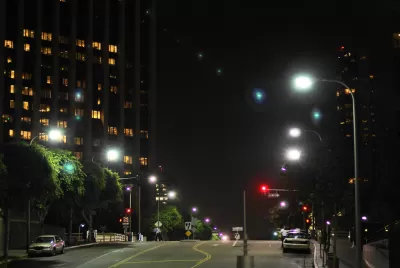
Los Angeles' LED streetlights are efficient, but the light they emit is a harsh blue-white. Adam Rogers writes, "The color of the city is changing, literally [...] at night, lights bring color back to LA—in a characteristic, unnatural spectrum. Now that spectrum is changing, which means the city's identity will be transformed, too."
Just like in New York, the city switched to the new lights for pragmatic reasons. "LEDs last years longer and kick out more than double the light per watt. Their lighter draw on the grid appealed to then-mayor Antonio Villaraigosa, who wanted the city to have a smaller carbon footprint. Ebrahimian predicted saving $7 million a year on electricity and $2.5 million in maintenance." LEDs also have smart city potential, such as blinking to indicate the approach of emergency vehicles.
But streets and buildings lit by LEDs, arguably, just aren't the same. "LEDs, for example, look white or blue-white to the naked eye. But they often drop the blues or reds at either end of the spectrum. Things that would look yellowish under full-spectrum sun or incandescent light may look white under LEDs. Skin tones look unnatural, even dead."
Read the full story: What Color is My City?


Planetizen Federal Action Tracker
A weekly monitor of how Trump’s orders and actions are impacting planners and planning in America.

Amtrak, CN end decades-long dispute with eight-year agreement
The new operating agreement establishes an updated framework for the companies to work together, including processes to resolve disputes.

Judges permit Denver to divert 77,000 acre feet from the Colorado River for reservoir expansion
Overuse and climate change have caused the Colorado River’s water levels to plummet.

Atlanta City Council unanimously backs $3.5 billion Beltline light rail project
The resolution was drafted after Atlanta Mayor Andre Dickens pulled support for the Atlanta Streetcar extension last year.

SEPTA to bring nearby frequent transit to over 1 million new riders as part of decade-long plan
The agency's Accelerate plan will also bring frequent transit to twice the amount of jobs that are currently located near it.

NYC plants over 18,000 trees, the most new foliage in a decade
Many of the trees were planted in communities vulnerable to extreme heat.

FREE Course: Walkable City 1: Why Walkability?
After describing his path towards focusing on walkability as the essence of good planning, Jeff Speck marches through his five principal reasons for making more walkable places.
Reinventing Malls: Planning Alchemy—Turning Gray Fields Into Gold
The course focuses on the opportunities and imperatives that shape reinvention of mall sites.

City of Thousand Oaks
City of Wisconsin Rapids
Harvard University Graduate School of Design
The Architects Foundation
University of Cincinnati Online
The Pocatello Development Authority
The Urban Renewal Agency of the City of Pocatello