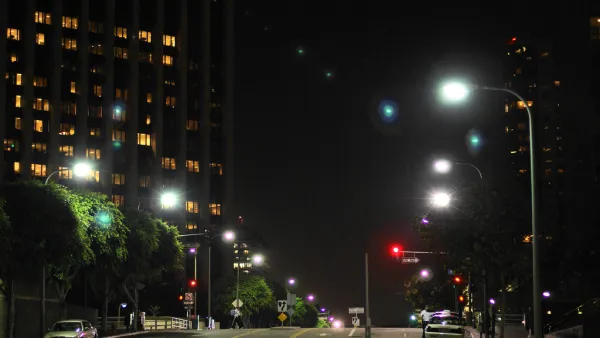
Los Angeles recently completed a comprehensive installation of LED streetlights—and New York City is not far behind. Among the unintended consequences of the new technology? Cities will now look completely different on film.


Dave Kendricken provides a fascinating examination of a pervasive change that might have gone unnoticed to the untrained eye—the new light spectrum emitted by LED streetlights. Taking Los Angeles as the most commonly filmed example (the city also recently completed a comprehensive LED retrofit of its streetlights), Kendricksen does a great job of balancing scientific explanations with the aesthetic descriptions of phenomena that will become more and more common as cities switch to LED lighting. The crux of the issue, from a filmmaking standpoint: “The interesting thing about non-tungsten artificial light sources is that they often produce a non-continuous or incomplete spectral output. This can affect the appearance of certain colors under that output.”
In case you’re wondering whether that’s a good thing for filmmakers: “The LEDs should very well prove a benefit to existing-light photography — better for the environment, and in nearly every case, better for cinematography.” (That news should come as a relief to urban designer, who have increasingly run afoul of the interests of Los Angeles filmmakers in recent years.)
To see the effect before your very eyes, Curbed LA has a display which allows you to swipe between before and after images to do a side by side comparison of the effect of the LED lights on the nighttime streetscape.
Read the full story: Why Hollywood Will Never Look the Same Again on Film: LEDs Hit the Streets of LA and NY
Los Angeles Changes Color
Adam Rogers chronicles Los Angeles' long and intimate relationship with the electric light. The city's recent choice to adopt LED streetlights has transformed a classic nighttime into something new.
Ahead of Schedule: Detroit Wrapping Up Installation of 40,000 LED Streetlights
In perhaps the brightest sign yet of recovery, the Detroit Public Lighting Authority has made incredible progress on a project to install 40,000 LED streetlights around the city's residential neighborhoods.
How LEDs Re-Illuminate the Urban Night Sky
Forbes Magazine reflects on the importance and impacts of light-emitting diode (LED) lights as more cities replace their traditional streetlamps with LEDs.

Desperate measures: Advocates weigh draining Lake Powell to fill Colorado River
Draining the reservoir could reduce evaporation losses by a couple hundred thousand acre-feet.

Eastern Nebraska is running out of electricity
Data centers and electrification are straining eastern Nebraska’s grid, throttling economic development.

Malls are becoming the midtowns of the future
Mall and office park redevelopments are a generational opportunity to create new nodes of urbanity.

NYC breaks ground on anti-flooding infrastructure project
New York City's new system will reduce stormwater flows to local sewers by 90%.

One Kentucky town’s secret to affordable housing
The Smoketown Community Land Trust has already built seven affordable homes for community members.

Houston gains petal-shaped cooling infrastructure to make streets more ‘delightful’
The city has installed the pavilions along 15 blocks in Houston.

FREE Course: Walkable City 1: Why Walkability?
After describing his path towards focusing on walkability as the essence of good planning, Jeff Speck marches through his five principal reasons for making more walkable places.
Reinventing Malls: Planning Alchemy—Turning Gray Fields Into Gold
The course focuses on the opportunities and imperatives that shape reinvention of mall sites.

City of Rosemead
Rutgers University, Edward J. Bloustein School of Planning and Public Policy
One Hundred Miles
University of Michigan School for Environment and Sustainability (SEAS)
Hunter College, City University of New York (CUNY)
The Architects Foundation
City of Cambridge
Montrose County
The Pocatello Development Authority