The Minneapolis area yields two case studies of troubled sites, home to big box retailers, finally rejoining the community.


Bill Lindeke tells the story of the Lake Street Kmart in Minneapolis, which interrupts the city's most famous street, Nicollet Avenue, on its way to and from downtown.
According to Lindeke, "[The Kmart is] a remnant of desperate times, when Minneapolis tried to bulldoze its way to economic relevance by creating an urban shopping mall. When the original deal fell through, faced with vacant lots, the City Council reluctantly turned to a Kmart proposal that came with a bitter poison pill: replacing one of the city’s key intersections with a massive parking lot straight out of the suburbs."
Such a development presents challenges for "reuse and rehab," according to Lindeke, but he finds examples of redevelopment progress, "after years of struggle and blight," with some examples in Cottage Grove and Minneapolis.
In the Cottage Grove example, a Home Depot in the city's Gateway North area closed eight years ago. For years, the city found it difficult to find a replacement tenant for the building or to redevelop the site. Recently, however, Iowa-based grocer Hy-Vee has been announced as the new tenant in the 116,000-square-foot building. Lindeke offers more details on the difficulties in finding a new tenant, which even involved an episode with the mayor of the city stopping just short of calling for a boycott of Home Depot.
Meanwhile, back at the Lake Street Kmart in Minneapolis, Peter Callaghan recently reported progress for conditions at that location, when city officials approved a $5.3 million purchase of some of the site. Another purchase option for the rest of site is expected soon. Callaghan's coverage of that development pitches the purchase as a chance to reconnect Nicollet Avenue.
Read the full story: The white elephant in the room — what to do with an old big-box store?

48-Acre Mega-Development Taking Shape on Minneapolis Waterfront
The Minneapolis City Council will consider initial mixed-use development plans for critical riverfront industrial site surrounded by a struggling residential neighborhood.

Looking Back on 60 Years of Land Development in the Twin Cities
In 1960, about 12 percent of the Twin Cities metro's land was already developed. By 2020, about 34 percent had been developed. Many factors influenced how the region has changed since 1960.
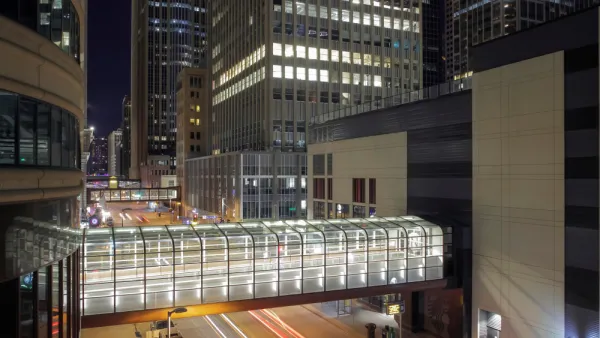
The Pandemic Has Not Been Kind to Pedestrian Skyways in the Twin Cities
Already a source of eternal controversy for their effects on street life and local business, pedestrian skyways have proven even more problematic during the pandemic.

Planetizen Federal Action Tracker
A weekly monitor of how Trump’s orders and actions are impacting planners and planning in America.

Washington state to charge fee to drivers with fuel-efficient cars
Revenue from the fee will go towards supporting the state’s highways.

Illinois considers spending $1 billion in taxpayer money on data center
A quantum computing campus and data center are currently under construction in Chicago.

Senate passes bill overhauling permitting
The bill still needs to pass the House.

Did data centers change how voters cast their ballots?
Texas, Ohio, and Georgia all flipped party control. But in rural counties, the effect of local data centers was mixed.

Amtrak invests in eight new Airo trainsets
The new trainsets will begin serving passengers in 2031.

FREE Course: Walkable City 1: Why Walkability?
After describing his path towards focusing on walkability as the essence of good planning, Jeff Speck marches through his five principal reasons for making more walkable places.
Reinventing Malls: Planning Alchemy—Turning Gray Fields Into Gold
The course focuses on the opportunities and imperatives that shape reinvention of mall sites.

City of Charlotte
City of Rosemead
Rutgers University, Edward J. Bloustein School of Planning and Public Policy
University of Michigan School for Environment and Sustainability (SEAS)
Hunter College, City University of New York (CUNY)
The Architects Foundation
University District Partnership