Seniors are on the cutting edge of a movement to make Neighborhood Electric Vehicles (NEVs), otherwise known as golf carts, a viable form of everyday transportation.


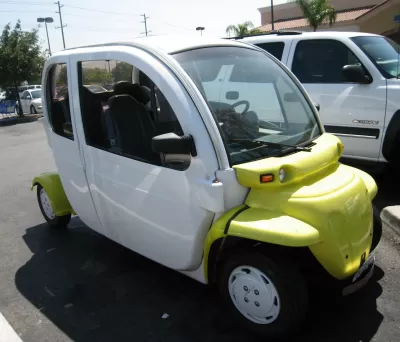
They're already used widely in parks, college campuses, enclosed communities, and, of course, golf courses. Now small towns are jumping on board in a push to make NEVs and other low-speed electrics the "cars" of choice for those who don't need to travel far. They're also much cheaper than full-size EVs.
In an odd twist, seniors are the demographic most suited to pioneer this transportation innovation. "Dozens of communities have outlined schemes to integrate carts and similarly sized vehicles into their transportation networks," particularly places where older folks tend to live, and not limited to retirement communities.
Sun Belt suburbs, so long the domain of soccer-mom SUVs and vanity pickup trucks, are poised to embrace the humble electric golf cart. "Why drive a cart? Certainly, disposable income, warm weather, and relatively dense settlements are prerequisites. But drivers also say that NEVs allow for old-fashioned urban social interaction."
The golf cart's potential isn't limited to Arizona retirees: "In beach towns and other compact tourist enclaves, already accustomed to a mix of transportation modes, NEVs can do a car's job with ease." No highway commutes though: the NEV demands more compact planning.
Read the full story: Why Towns Are Falling In Love With Golf Carts
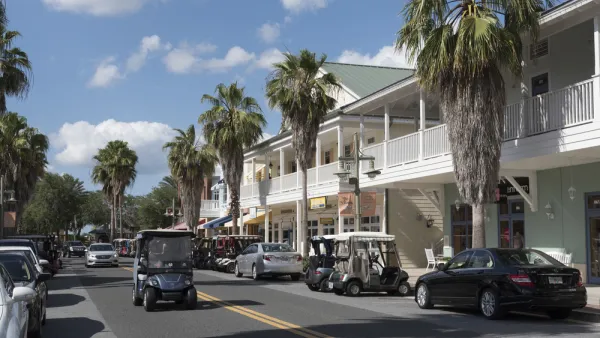
The Villages and the Dangers of Holding Too Tightly to the Past
Some parts of The Villages, Florida, the nation's largest retirement community and one of its most popular master planned communities, bear a striking resemblance to the neotraditional development favored by famous early examples of New Urbanism.
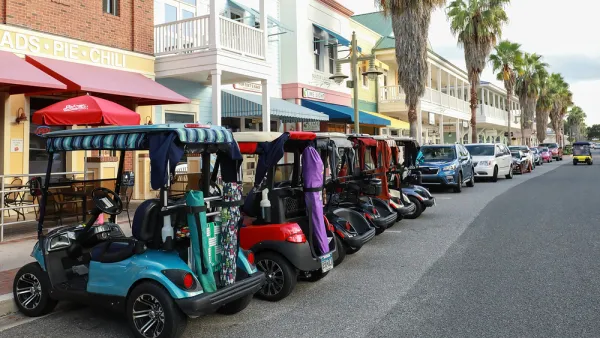
Why Golf Carts Could Quietly Revolutionize Transportation
More communities are catching on to the benefits of golf carts as a safe, low-emissions mode of transport for neighborhood trips.
Golf Carts as Transportation
Designing roads for low-speed vehicles like golf carts can make getting around safer and easier for seniors.

Planetizen Federal Action Tracker
A weekly monitor of how Trump’s orders and actions are impacting planners and planning in America.

California plans to bury El Niño’s downpour
If the state plays its cards right, it may be able to store a billion acre-feet of El Niño’s water in aquifers.

Desperate measures: Advocates weigh draining Lake Powell to fill Colorado River
Draining the reservoir could reduce evaporation losses by a couple hundred thousand acre-feet.

US buildings threatened, destroyed by fires set to triple by 2060
Researchers found a high fire risk for socioeconomically vulnerable neighborhoods in the American West.

LA residents may be allowed to paint their own crosswalks
Councilwoman Katy Yaroslavsky put out a motion instructing the Los Angeles Department of Public Transportation to study the feasibility of allowing volunteers to paint crosswalks.

Dallas moves to overhaul its zoning code
The city's zoning reform will allow more multi-family and mixed-use developments.

FREE Course: Walkable City 1: Why Walkability?
After describing his path towards focusing on walkability as the essence of good planning, Jeff Speck marches through his five principal reasons for making more walkable places.
Reinventing Malls: Planning Alchemy—Turning Gray Fields Into Gold
The course focuses on the opportunities and imperatives that shape reinvention of mall sites.

City of Rosemead
Rutgers University, Edward J. Bloustein School of Planning and Public Policy
One Hundred Miles
Hunter College, City University of New York (CUNY)
The Architects Foundation
University of Cincinnati Online
City of Cambridge
Montrose County
The Pocatello Development Authority