Once called the "Champs-Élysées of Los Angeles," MacArthur Park later became known for crime and prostitution. While it has yet to experience a revival like other L.A. parks, an unusual public art project has generated renewed interest in the park.


MacArthur Park in Los Angeles is the scene of an unusual and colorful art project. Three thousand spheres—painted with artistic designs by over ten thousand people—have been floating in the park's lake.
Opened in 1890, the park was loved by the people of Los Angeles and offered the perfect venue for leisurely strolls, boating in a lake, and popular Sunday concerts. The park was surrounded by luxury hotels and the area even became known as the Champs-Élysées of Los Angeles. . . the park [later] became known for violence and crime after 1985 when gangs, shoot-outs, prostitution, and drug dealing became commonplace. Over the years, the City of Los Angeles has undertaken various efforts to improve the park, such as the installation of surveillance cameras, the creation of a recreation center, and the opening of Levitt Pavilion which offers free concerts.
Los Angeles County planner Clement Lau. He goes on to note, however, the park has yet to experience the revival of other Los Angeles parks like Echo Park Lake or the redesign efforts focused on Pershing Square. Nevertheless, the public art project called The Spheres at MacArthur Park has attracted many visitors and generated renewed interest in the Park.
The Spheres display has been going-on all summer and was set to expire at the end of September. Luckily, you still have a chance to see it, if you haven't already (or see it again if you have) because it has been extended, through the CicLAvia - Heart of LA event on Sunday, 10/18, when key central Los Angeles streets will be open only to bicyclists, pedestrians, and other active-transiters.
Read the full story: What about MacArthur Park?

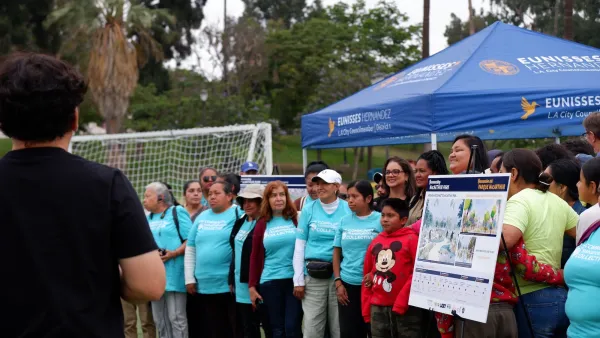
LA unveils plans to reconnect MacArthur Park
The construction of Wilshire Boulevard split the park in two in 1934.
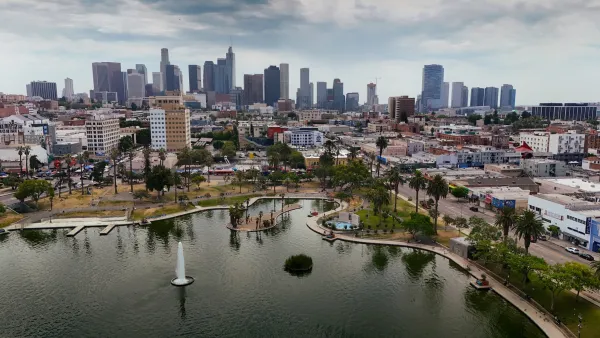
World Cup renews community spirit in LA's MacArthur Park
Soccer watch parties are bringing life back to the park that was recently the target of immigration raids and police actions.
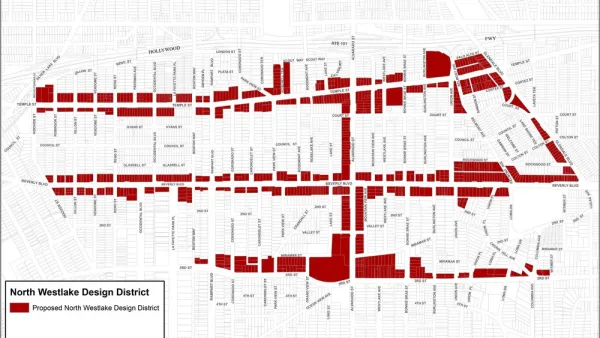
L.A. Tenants Link Planned 'Design District' to Displacement
Community leaders say a design district in Westlake could pave the way for the erasure of L.A's Historic Filipinotown.

Planetizen Federal Action Tracker
A weekly monitor of how Trump’s orders and actions are impacting planners and planning in America.

The state-sanctioned urbicide of Austin
People don’t kill cities. Freeways do.

US to reduce Colorado River water deliveries to Mexico
A new Colorado Treaty amendment reduces Mexico’s Colorado River water allocation by 250,000 acre feet.

Nation's most wind-powered state turns to coal as data centers increase energy demand
For the first time in decades, Iowa has increased its generation of coal power.

NYC cools commuters with city's first rain garden above a bus stop
New York City officials say the plants in the rain garden can absorb 16 gallons of rainwater during heavy storms.

Brightline West’s future may rely on $6 billion federal loan
The company has until Nov. 2 to make a $400 million equity investment into its proposed high-speed rail line.

FREE Course: Walkable City 1: Why Walkability?
After describing his path towards focusing on walkability as the essence of good planning, Jeff Speck marches through his five principal reasons for making more walkable places.
Reinventing Malls: Planning Alchemy—Turning Gray Fields Into Gold
The course focuses on the opportunities and imperatives that shape reinvention of mall sites.

Greater Baltimore Committee
Eagle County Government
Harvard University Graduate School of Design
The Architects Foundation
University of Cincinnati Online
The Pocatello Development Authority
The Urban Renewal Agency of the City of Pocatello
Journal of the American Planning Association