Traffic fatalities in California have been rising since 2010, rising to 3,104 in 2013 after decreasing from 2006 to 2010. Experts point to several specific reasons for the increase; one of the most prominent may be in your hand right now.


The economy may seem like the likely cause for the reversal in traffic crashes, particularly with the increase coinciding closely with the end of the Great Recession, but Tony Bizjak, transportation reporter for the The Sacramento Bee, writes that the recovery helps explain the increase in the number of vehicles and vehicle-miles-traveled, but not necessarily fatalities.
In some ways, the connection seems obvious: More people on the roads means more fatal encounters. But state highway officials say that doesn’t have to be the case. Having more cars on the roads doesn’t always lead to more crashes. In some instances, crowded roads can make driving safer by forcing motorists to slow down and pay more attention. (For instance, crash rates on rural roads are higher than on urban streets.)
Distracted driving, a cause célèbre of former U.S. Secretary of Transportation Ray LaHood, seems like another likely reason. But Chris Cochran of the state Office of Traffic Safety, [a division of the California State Transportation Agency] "said it is uncertain how big a role distracted driving plays in crashes because drivers often don’t admit after a crash that they were on their phones rather than watching the road."
Even if motorists were to admit to using their phones, California's laws do not reflect today's technology. The 2007 cell phone law that bans "drivers using hand-held cellphones to talk and text" doesn't account for all the other uses of smart phones, as Cochran explains.
“Before, you could talk or text, and that was it. Now with a half-million apps, people practically run their lives off their cellphones. They check their stocks. They GPS. They play Candy Crush. They are watching movies.”
Is it time for new legislation to address the many uses of smart phones that can result in distracted driving?
A state appellate court last year ruled that a CHP officer was wrong to ticket a Fresno driver for consulting a map on his smartphone. The law also is silent on whether a driver can check Facebook while driving.
Caltrans pointed to another 'lifestyle' trend: "drugged-driving crashes are on the upswing," writes Bizjak. "Some of that may stem from older drivers taking prescription drugs that affect their driving ability. Marijuana use also is likely up, safety officials say."
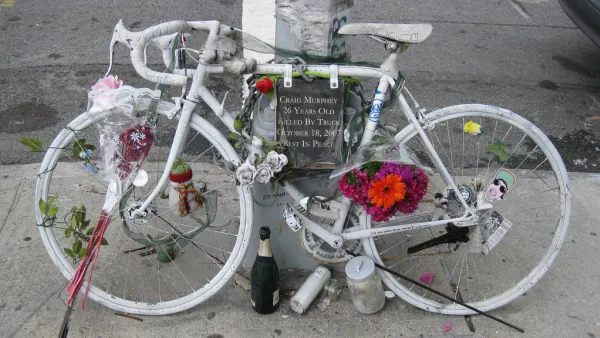
Also under 'lifestyle' is the increase in motorcycle and bicycle riding, particularly among older males, that has caused an increase in fatalities from prior years.
Whatever the reason, the result is that "(s)ince 2010, the death toll has ticked up annually, hitting 3,104 in 2013," notes Bizjak. That's still lower than 2006, when "4,300 people were killed on roads and highways," but higher than 2010, when 2,739 died. Officials expect the upward trend "to continue when 2014 numbers are finalized."
Hat tip: MTC-ABAG Library
Read the full story: Traffic deaths climbing in California – Is there a fix?

2015 Road Toll: 35,200 Fatalities
The National Highway Traffic Safety Administration (NHTSA) released preliminary fatality estimates for 2015. Deaths jumped by 2,525, an increase of 7.7 percent over 2014. Pedestrians and bicyclists saw the biggest increases.
It's not Zero, But Traffic Deaths Decreased Last Year in New York City
Traffic deaths dropped by 27 in 2015 to 230, a reduction of over 10 percent from 2014. Pedestrian deaths decreased only slightly. Bicyclists fared better: deaths dropped by 30 percent.
AAA Takes on Teenage Driving in New Study
Teenagers have a lot on their minds, which is not a bad thing, except when it comes to getting behind the wheel. A report released March 25 reveals that six out of ten teen crashes involve driver distraction—400 percent greater than a prior study.

Planetizen Federal Action Tracker
A weekly monitor of how Trump’s orders and actions are impacting planners and planning in America.

‘Going backwards:’ Baltimore mayor, students rally against state's transit funding plan
Maryland's proposed six-year plan provides no funding for Baltimore’s BMORE bus program and reduces its road maintenance funding.

Detroit to transform waterfront with $2.2 billion investment
Developers will convert about 18 acres of unused parking lot space into civic spaces.

HUD modernizes 50-year-old manufactured housing framework
The Next Generation Manufactured Housing Action Plan establishes new energy-efficiency standards for manufactured homes, and new guidelines for anchoring them.

New CA housing laws tear down development red tape
Recently-signed legislation makes building starter homes and ADUs cheaper and faster in California.

Metrolink finishes first expansion in 20 years
The transit agency is now one of very few in the United States to connect two major airports.

FREE Course: Walkable City 1: Why Walkability?
After describing his path towards focusing on walkability as the essence of good planning, Jeff Speck marches through his five principal reasons for making more walkable places.
Reinventing Malls: Planning Alchemy—Turning Gray Fields Into Gold
The course focuses on the opportunities and imperatives that shape reinvention of mall sites.

One Hundred Miles
County of Mendocino
planning NEXT
The Architects Foundation
University of Cincinnati Online
Montrose County
Northern Illinois Transit Authority (NITA)
The Pocatello Development Authority