Cities traditionally thought of as car-centric are putting ambitious light rail plans at the center of ambitious plans for transit.


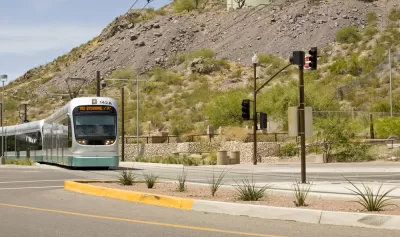
"Rail tracks are being laid in the unlikeliest of places," according to an article by William Fulton and Kyle Shelton. The unlikely places, according to the column, are found all over the Sun Belt—from Phoenix to Houston to Los Angeles to Denver.
The question Fulton and Shelton endeavor to answer: "What explains all this construction, especially in the traditionally auto-oriented South and West?" The short version of their answer: "Light rail is a lot faster than a bus, but doesn't cost nearly as much to build as a subway."
From a planning perspective, light rail lines represent "only one aspect of broader efforts to solve the public transportation puzzle," according to Fulton and Shelton. "Cities are increasingly connecting light rail lines with major nodes of activity and other transportation modes such as expanded express bus services or bike lanes."
The article includes a lot more details about how cities are approaching their new light rail lines, how they fit into larger planning and transportation considerations, and how light rail's detractors argue against such investments.
Read the full story: Why car-crazy cities are riding the rails

Questioning the Wisdom of Light Rail in the Sun Belt States
As Houston, Dallas and other sun belt cities build out their light-rail systems, some are asking if the investment is worth it.

Learning loss and urban schools, part 2
Did test scores in progressive cities drop more post-COVID than test scores in moderate ones?
New Transit Systems of 2010
Garrett Bradford of TheCityFix reviews some of the most innovative and sustainable transit systems from around the globe that made their debut over the last twelve months.

Planetizen Federal Action Tracker
A weekly monitor of how Trump’s orders and actions are impacting planners and planning in America.

California plans to bury El Niño’s downpour
If the state plays its cards right, it may be able to store a billion acre-feet of El Niño’s water in aquifers.

Chicago breaks ground on $3 billion megadevelopment
The new neighborhood, titled Foundry Park, will one day host 3,700 residences.

California High-Speed Rail Authority CEO resigns after $600,000 scandal
Under Ian Choudri, the authority used taxpayer dollars to fund first class flights and trips to nightclubs.

Want to study the Missouri River? Soon, you may need unanimous approval from 10 states
Legislation would require 10 governors’ permission to study or build projects moving water outside the basin.

Desperate measures: Advocates weigh draining Lake Powell to fill Colorado River
Draining the reservoir could reduce evaporation losses by a couple hundred thousand acre-feet.

FREE Course: Walkable City 1: Why Walkability?
After describing his path towards focusing on walkability as the essence of good planning, Jeff Speck marches through his five principal reasons for making more walkable places.
Reinventing Malls: Planning Alchemy—Turning Gray Fields Into Gold
The course focuses on the opportunities and imperatives that shape reinvention of mall sites.

City of Rosemead
Rutgers University, Edward J. Bloustein School of Planning and Public Policy
One Hundred Miles
Hunter College, City University of New York (CUNY)
The Architects Foundation
University of Cincinnati Online
City of Cambridge
Montrose County
The Pocatello Development Authority