The Technology section of the Money website expresses some surprise that the ambitious BlueIndy electric car sharing program is bound for Indy, and not some tech haven like San Francisco, Boston, or Austin.


"On Wednesday, the nation’s most ambitious electric car sharing program launches in a city that’ll probably surprise you," according to an article by Brad Tuttle.
Drum roll please? The city is Indianapolis, and the program BlueIndy, "is being run by a French company called the Bolloré Group, which says it is investing $41 million in the Indianapolis operation," reports Tuttle.
"The company has said BlueIndy will have 25 charging stations and 50 vehicles around the city at launch, and the plan is for 200 stations and 500 electric cars in the near future. The cars themselves are small white hatchbacks made by Bolloré, featuring the BlueIndy logo on the sides."
Tuttle also notes that the electric car sharing system will come as a welcome relief in a city with one of the worst transit systems in the country, according to an evaluation in FiveThirtyEight from July 2014.
Read the full story: Groundbreaking Electric Car Sharing Program Launches in an Unlikely City

Electric Car Share Comes to Detroit’s Eastside
The program is operated by the Eastside Community Network and funded through the U.S. Department of Energy.
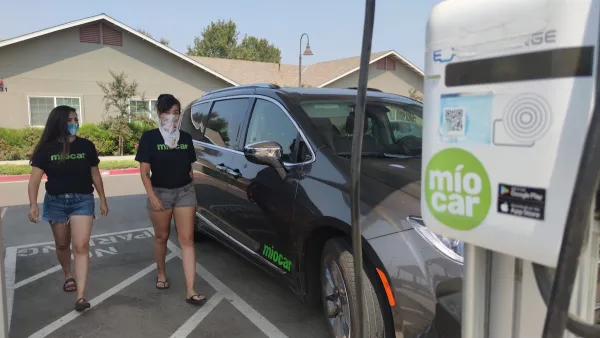
Car Sharing Co-op Boosts Mobility in California’s Central Valley
A nonprofit electric car sharing program offers hourly or daily rentals recently expanded to San Joaquin County.

Sacramento Plans for Electric Vehicle Infrastructure
The city wants to install a network of more than 3,000 charging stations, with a focus on underserved communities.

Planetizen Federal Action Tracker
A weekly monitor of how Trump’s orders and actions are impacting planners and planning in America.

California plans to bury El Niño’s downpour
If the state plays its cards right, it may be able to store a billion acre-feet of El Niño’s water in aquifers.

Desperate measures: Advocates weigh draining Lake Powell to fill Colorado River
Draining the reservoir could reduce evaporation losses by a couple hundred thousand acre-feet.

Mamdani’s pied-à-terre tax survives legal challenge
A panel of judges found that the plaintiffs failed to demonstrate injury as a result of New York City's implementation of the tax.

Eastern Nebraska is running out of electricity
Data centers and electrification are straining eastern Nebraska’s grid, throttling economic development.

Seattle passes record-breaking transit services expansion
Proposition 1 will double the city’s transit tax to add 95,000 more bus trips and preserve 180,000 bus trips annually.

FREE Course: Walkable City 1: Why Walkability?
After describing his path towards focusing on walkability as the essence of good planning, Jeff Speck marches through his five principal reasons for making more walkable places.
Reinventing Malls: Planning Alchemy—Turning Gray Fields Into Gold
The course focuses on the opportunities and imperatives that shape reinvention of mall sites.

City of Rosemead
Rutgers University, Edward J. Bloustein School of Planning and Public Policy
One Hundred Miles
University of Michigan School for Environment and Sustainability (SEAS)
Hunter College, City University of New York (CUNY)
The Architects Foundation
City of Cambridge
Montrose County
The Pocatello Development Authority