Planning Commission hearings related to the SF-based real estate empire of the Stephens family shed light on a history of land use violations in a land-scarce city.


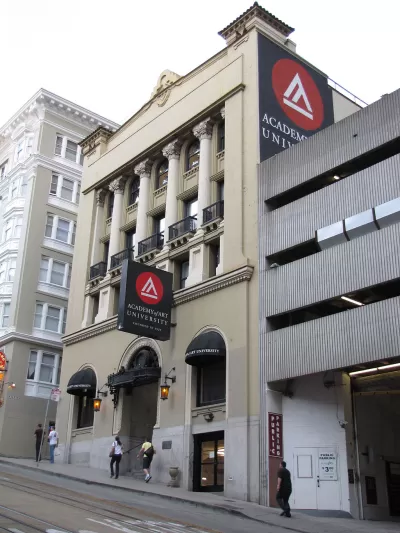
The Academy of Art University (AAU) in San Francisco has been owned by the Stephens family since its establishment in 1929. The website for the university states that "The Academy and San Francisco have grown up together," but some city residents believe the for-profit institution's growth has occurred without regard for land-use laws and in the face of a critical housing shortage.
Elisa Stephens, President of AAU, is referred to by her father, the university's founder, as the Princess, but former Planning Commissioner Ron Miguel refers to her as a scofflaw. Miguel was among those to offer public comment at a recent planning commission hearing to address the status of AAU's 31 planning code violations. Those violations relate mostly to a failure to obtain permits for converting over 40 buildings in prime SF locations to use for the school. According to Forbes reporter Katia Savchuk, these properties include rent-controlled housing.
"The Stephens family has turned that pile of art-school tuition into one of the largest real estate empires in San Francisco, with more than 40 properties in prime areas," Savchuk notes in a related article. Meanwhile, "In the 2013-14 academic year 55% of the school’s roughly 10,700 undergraduates had federal student loans totaling $45 million."
Savchuk reports on a vast network of political connections the Stephens family has cultivated over decades, including close ties to former Mayor Willie Brown and current Mayor Ed Lee.
"As enforcement limps on, AAU has continued buying new properties, and in some cases continuing to change the use of the buildings without informing authorities."
An environmental impact report is expected next year. Savchuck writes, "AAU plans to add another 1.2 million square feet in San Francisco by 2020, without building any new facilities, according to the report. If allowed, that would 'displace substantial numbers of people' from housing and businesses, the report says."
Read the full story: How A For-Profit University Flouts San Francisco's Land-Use Laws
Voters choose public transit, approve $31 billion in funding
Approved projects include $101,000 for reduced-cost transit in a Michigan town and $14 billion for regional transit in the San Francisco Bay Area.

Bay area voters pass ‘crucial lifeline’ for transit
Proposition RTM, which will fund Bay Area transit, has approval from 61% of voters as of 9:45 p.m. on Nov. 3.

California High-Speed Rail Authority picks trainset manufacturer
The California High-Speed Rail Authority aims to start servicing passengers by 2033.

Desperate measures: Advocates weigh draining Lake Powell to fill Colorado River
Draining the reservoir could reduce evaporation losses by a couple hundred thousand acre-feet.

Eastern Nebraska is running out of electricity
Data centers and electrification are straining eastern Nebraska’s grid, throttling economic development.

Move over, LA: St. Louis gears up for Olympics, invests millions in downtown redevelopment
The Missouri city will host the 2028 Olympic soccer group stage and knockout matches.

Mass. votes against statewide minimum lot size for single-family homes
Over 2 million residents voted on Question 7; it was decided by just over 30,000 votes.

Maryland’s $15 billion bridge project gains key approval
The Maryland Transit Authority said the project will create over 60,000 jobs and add $23 billion to the local economy.

‘No clear next steps’ for Chicago's permanent festival grounds
Eleventh Ward Ald. Nicole Lee has suggested Soldier Field as a possible location for the permanent event space.

FREE Course: Walkable City 1: Why Walkability?
After describing his path towards focusing on walkability as the essence of good planning, Jeff Speck marches through his five principal reasons for making more walkable places.
Reinventing Malls: Planning Alchemy—Turning Gray Fields Into Gold
The course focuses on the opportunities and imperatives that shape reinvention of mall sites.


City of Rosemead
Rutgers University, Edward J. Bloustein School of Planning and Public Policy
One Hundred Miles
University of Michigan School for Environment and Sustainability (SEAS)
Hunter College, City University of New York (CUNY)
The Architects Foundation
City of Cambridge
The Pocatello Development Authority
The Urban Renewal Agency of the City of Pocatello