Cities around the world have continued to implement drastic measures in reaction to a proliferation of billboards.


Arwah Mahdawi examines the spreading influence of the city of São Paulo's 2007 Clean City Law:
"In the last decade, from Bristol to Tehran, there been a global movement to un-brand cities – to rid them, at least partially, of adverts. Citizen vigilantes, artists and activists are playing important roles. Etienne Lavie, for example, has re-imagined what cities would look like if classical paintings replaced adverts; a team of developers in New York has created No Ad, an augmented-reality app that strips the New York City subway of ads, replacing them with art; and in 2008 a group of Bristol citizens petitioned (albeit unsuccessfully) to ban advertising from the city."
The work of those citizen vigilantes, according to Mahdawi, has also produced policy change from municipalities:
"In 2009, Chennai, India banned the erection of billboards, and several US states including Vermont, Maine, Hawaii, and Alaska are billboard-free. In 2011, Paris set out plans to reduce the number of ad hoardings by a third. And earlier this year, Tehran replaced all its 1,500 advertising billboards with art for 10 days."
The article goes on to examine a few surprising arguments for keeping billboards, the case made by the aforementioned vigilantes, and the consequences of the decision to remove 15,000 billboards and 300,000 over-sized storefront signs from São Paulo.
Read the full story: Can cities kick ads? Inside the global movement to ban urban billboards

Brazilian Billboard Ban Under Pressure
The ban on billboard advertising in Sao Paulo, Brazil, is showing pressure cracks, as continued opposition to the citywide policy has some lawmakers considering a repeal.
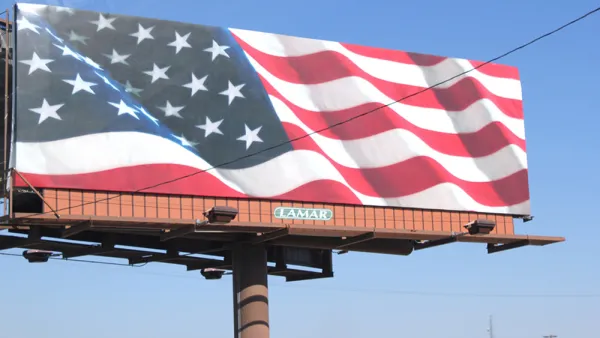
Supreme Court Case Could Transform Sign Regulations
If the Supreme Court upholds a lower court decision, cities could lose a long-standing right to regulate 'off-premises' billboards.
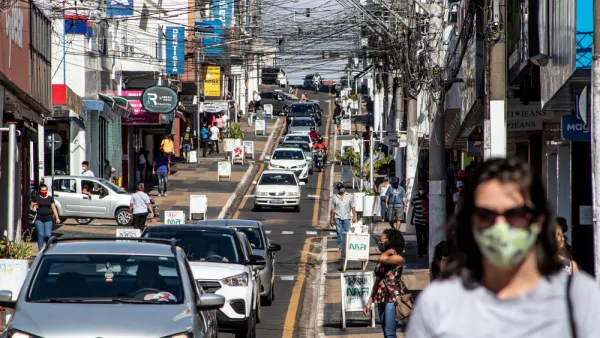
The World's Worst COVID Outbreak
Brazil has surpassed the U.S. and led the world in the daily average of COVID-19 deaths and coronavirus infections during the last week. Experts point to a coronavirus variant and the lack of a federal strategy, leaving states without assistance.

Planetizen Federal Action Tracker
A weekly monitor of how Trump’s orders and actions are impacting planners and planning in America.

Amtrak, CN end decades-long dispute with eight-year agreement
The new operating agreement establishes an updated framework for the companies to work together, including processes to resolve disputes.

Judges permit Denver to divert 77,000 acre feet from the Colorado River for reservoir expansion
Overuse and climate change have caused the Colorado River’s water levels to plummet.

NYC DOT wants faster, more permanent street upgrades
The city is examining ways to build more concrete infrastructure without getting entangled in 'decades-long' projects.

'Something we’ve never seen before:' rising utility rates could strain city finances nationwide
Data centers, climate change and other factors have caused utility rates in the United States to increase by 38% since 2020.

Trump to overrule local leaders, lease millions of acres of America’s Pacific Island territories’ seafloors to mining companies
International law says that the Indigenous people of America’s territories have a right to prior and informed consent regarding projects that impact their countries.

FREE Course: Walkable City 1: Why Walkability?
After describing his path towards focusing on walkability as the essence of good planning, Jeff Speck marches through his five principal reasons for making more walkable places.
Reinventing Malls: Planning Alchemy—Turning Gray Fields Into Gold
The course focuses on the opportunities and imperatives that shape reinvention of mall sites.

Harvard University Graduate School of Design
KFH Group Inc.
Greater Baltimore Committee
The Architects Foundation
University of Cincinnati Online
The Pocatello Development Authority
The Urban Renewal Agency of the City of Pocatello