Among other traits, science-minded planners must seriously reflect on what it is they know about their field, seeking good reasons and solid evidence for why they accept those things, writes Jodie Sackett, a Los Angeles County urban planner.


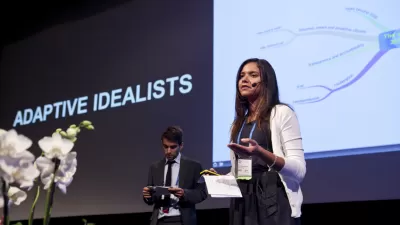
A planner who develops new theories and tests them, can find hypotheses hidden within typical planning-related statements (such as objectives, principles, and policies); comprehends the difference between a statement that is self-evident and one that is not; and understands that there are no absolute proofs in science "just might be an urban scientist" according to L.A. County urban planner Jodie Sackett.
Sackett goes on to share several (sometimes fun) "markers" that planners can use to help determine if they are science-oriented thinkers, from "progressivism" to the "fountain of rational inquiry" to the ability to see "failure as victory."
Read the full story: Are You an Urban Scientist?
Can Science Save Planning from Extinction?
In a recent paper, urban theorist Stephen Marshall rehashes Jane Jacobs's criticism of city planning as a pseudoscience built "on a foundation of nonsense." Can science and design be reconciled to provide planning a more stable foundation?

Evidence-based planning in a time of information overload
The field of academic publishing has become complex and crowded. What does it mean for urban planners?

Children in 55 countries are redesigning their cities in Minecraft
A U.N.-backed program lets students and community members reimagine sites in their neighborhoods in the game — and translate them into real-life buildings.

Planetizen Federal Action Tracker
A weekly monitor of how Trump’s orders and actions are impacting planners and planning in America.

California plans to bury El Niño’s downpour
If the state plays its cards right, it may be able to store a billion acre-feet of El Niño’s water in aquifers.

Desperate measures: Advocates weigh draining Lake Powell to fill Colorado River
Draining the reservoir could reduce evaporation losses by a couple hundred thousand acre-feet.

Housing is the top priority of Seattle’s sole new councilmember
Jenks campaigned on building 1,000 new units of affordable housing.

New tax cuts may slash $1.5 billion in funding for Miami transit, public parks
Amendment 3 will save Miami-Dade homeowners $2,700 in 2028.

Arizona, Wisconsin, Pennsylvania hope to finally advance climate goals post-midterms
The three states have spent years under Republican or divided control.

FREE Course: Walkable City 1: Why Walkability?
After describing his path towards focusing on walkability as the essence of good planning, Jeff Speck marches through his five principal reasons for making more walkable places.
Reinventing Malls: Planning Alchemy—Turning Gray Fields Into Gold
The course focuses on the opportunities and imperatives that shape reinvention of mall sites.

City of Rosemead
Rutgers University, Edward J. Bloustein School of Planning and Public Policy
One Hundred Miles
University of Michigan School for Environment and Sustainability (SEAS)
Hunter College, City University of New York (CUNY)
The Architects Foundation
City of Cambridge
Montrose County
The Pocatello Development Authority