This vehicle would be larger than a Hummer, a bus, and even an 18-wheeler. Then again, it would not travel on land. The proposal goes by an appropriate acronym: SF-BREEZE. Think fresh air over the bay.


San Francisco Bay may have fewer ferries operating than Puget Sound in Washington State, but if the BREEZE proposal comes to fruition, it will have the greenest.
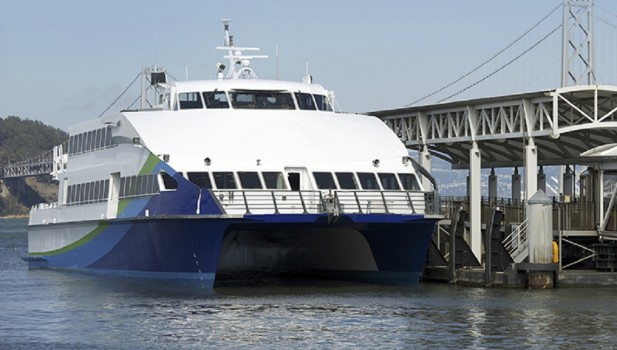
Credit: U.S. Maritime Administration (MARAD)
The concept behind the San Francisco Bay Renewable Energy Electric vessel with Zero Emissions (SF-BREEZE) is "to design, build, and operate a high-speed hydrogen fuel cell passenger ferry and hydrogen refueling station," according to Sandia National Laboratory, which is operated for the U.S. Department of Energy’s National Nuclear Security Administration.
This undertaking is by Sandia's Energy & Climate division. It signed an agreement with Red and White Fleet, a cruise tour operator in San Francisco Bay, to work toward eliminating smokestack emissions.
The proposal received a grant from the U.S. Department of Transportation's Maritime Administration (MARAD) for half a million dollars toward "a feasibility study of a high-speed passenger ferry with a hydrogen fuel cell, and of a hydrogen refueling station that would service the ferry, [fuel cell] electric cars, buses, fleet vehicles and other fuel cell-powered marine vessels," writes AASHTO Journal. "(T)he multi-use hydrogen refueling station would be the largest in the world."
"This study is just one more way in which MARAD is working to find new and efficient technologies for use in the maritime industry that offer clean-fuel options to cut emissions," said Administrator Paul 'Chip' Jaenichen.
A fuel cell powered ferry would consume as much hydrogen fuel in one day as 200 cars would in one week, according to Environmental News Service.
"If the feasibility study indicates that SF-BREEZE could succeed technically, economically and within regulations, the next step is to design the vessel," according to Sandia's press release. "The project will need additional funding, resources and partners, which could come from the federal government, the state of California, investors, industry or private foundations."
On the East Coast, "MARAD is also funding an effort to demonstrate a fuel cell for ship auxiliary power for its school ship Kennedy, which is used by Massachusetts Maritime Academy as a training vessel."
Correspondent's notes: Fuel cell vehicles are a type of electric vehicles. As for the "renewable" part of the acronym, look for a 'comment' below the post if I find out.
Read the full story: Study Eyes Fuel Cell-Powered Ferry, Refueling Station That Also Serve Vehicles

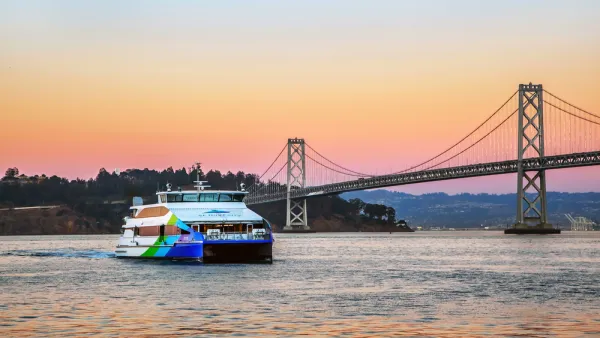
Electrifying Maritime Transport – San Francisco Bay to Show the Way
While battery-power doesn't appear practical, electricity from fuel cells does. The nation's first fuel cell-powered ferry will be operating in San Francisco Bay next year thanks in part to a $3 million grant from the California Air Resources Board.
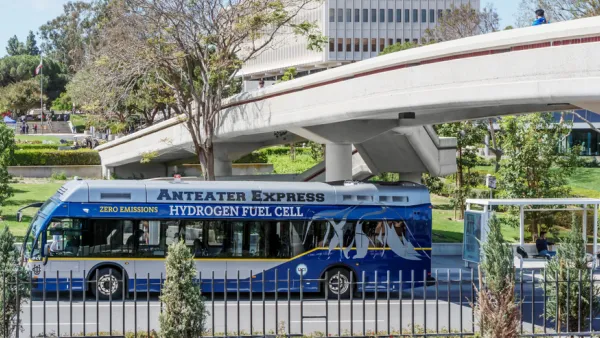
Can Hydrogen Make a Comeback?
While hydrogen fuel cell electric vehicles are much less popular than their battery-powered siblings, California remains committed to the zero-emission technology, with three state agencies investing in and monitoring its progress.
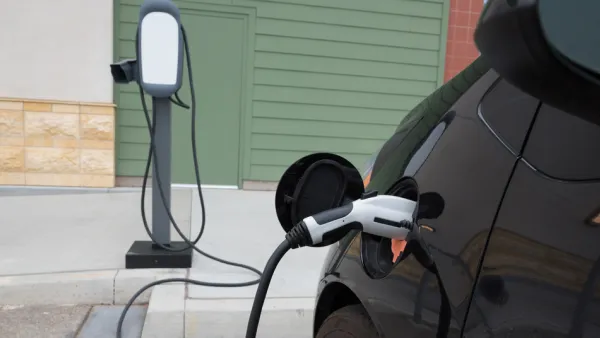
Gov. Jerry Brown Calls for Five Million ZEVs on California Roads by 2030
The executive order calls for $2.5 billion for rebates and electric charging and hydrogen fueling stations, subject to approval by legislature. His earlier executive order called for 1.5 million zero-emission vehicles by 2025.

Planetizen Federal Action Tracker
A weekly monitor of how Trump’s orders and actions are impacting planners and planning in America.

Amtrak, CN end decades-long dispute with eight-year agreement
The new operating agreement establishes an updated framework for the companies to work together, including processes to resolve disputes.

Judges permit Denver to divert 77,000 acre feet from the Colorado River for reservoir expansion
Overuse and climate change have caused the Colorado River’s water levels to plummet.

NYC DOT wants faster, more permanent street upgrades
The city is examining ways to build more concrete infrastructure without getting entangled in 'decades-long' projects.

'Something we’ve never seen before:' rising utility rates could strain city finances nationwide
Data centers, climate change and other factors have caused utility rates in the United States to increase by 38% since 2020.

Trump to overrule local leaders, lease millions of acres of America’s Pacific Island territories’ seafloors to mining companies
International law says that the Indigenous people of America’s territories have a right to prior and informed consent regarding projects that impact their countries.

FREE Course: Walkable City 1: Why Walkability?
After describing his path towards focusing on walkability as the essence of good planning, Jeff Speck marches through his five principal reasons for making more walkable places.
Reinventing Malls: Planning Alchemy—Turning Gray Fields Into Gold
The course focuses on the opportunities and imperatives that shape reinvention of mall sites.

Harvard University Graduate School of Design
KFH Group Inc.
Greater Baltimore Committee
The Architects Foundation
University of Cincinnati Online
The Pocatello Development Authority
The Urban Renewal Agency of the City of Pocatello