Renewable diesel, a biofuel that differs from biodiesel by the feedstock used and its chemical makeup, making it indistinguishable from petrodiesel, is a small but growing industry. The announcement from UPS was welcome news for three companies.


"On (July 29), UPS plans to announce that it will buy as much as 46 million gallons of renewable diesel over the next three years, helping the company reach a goal of displacing 12 percent of the petroleum-based fuels in its ground fleet by 2017," writes Diane Cardwell, Business Day reporter for The New York Times.
The renewable fuels, from three suppliers [noted below], are chemically so close to their petroleum-based counterparts that they can replace them in engines and pipelines. They are made from an array of bio-based sources, including palm* and waste oils, and animal fats.
Renewable diesel is not biodiesel. Here's an explanation from Advanced Biofuels:
- Biodiesel is chemically different from petrodiesel and renewable diesel
- Renewable Diesel, often called “green diesel” or “second generation diesel,” refers to petrodiesel-like fuels derived from biological sources that are chemically not esters and thus distinct from biodiesel. Renewable diesel is chemically the same as petrodiesel, but it is made of recently living biomass
In addition, the feedstock need not be from edible crops. A 2013 study published in the Proceedings of the National Academies of Science found that "up to five percent of grasslands in some states are converted to cropland each year to grow corn and soybeans for ethanol and biodiesel." A 2009 report from the Environmental Defense Fund indicated that emissions from biofuels are undercounted.
"Unlike ethanol or other biofuels, said Mike Whitlatch, vice president for global energy and procurement at UPS, there are no limits on how much renewable diesel can be blended with conventional fuel, so building the market is 'purely a function of how many bio-refineries are built and how much renewable diesel they can produce,'” adds Cardwell.
The market for renewable diesel is much smaller than for biofuel and ethanol — a little more than a billion gallons is produced each year, said Victor Oh, an analyst at Lux Research. But the market is growing faster, he said, and is expected to reach 1.6 billion gallons in the next three years, largely driven by demands for renewable jet fuel.
UPS will purchase renewable diesel from three sources:
- Neste, a Finnish company that is the leading producer of renewable diesel, "including more than half from waste and residues," notes the UPS press release.
- Renewable Energy Group, based in Ames, Iowa, "produces renewable hydrocarbon diesel fuel from waste vegetable oils and animal fats at its Geismar, Louisiana, bio-refinery as well as biodiesel at nine bio refining locations in the U.S.", per press release.
- Solazyme, based in South San Francisco, Calif. which makes an algae-derived oil that is refined into renewable diesel.
Hat tip to Bill Magavern, Policy Director, Coalition for Clean Air.
FULL STORY: UPS Agrees to Buy 46 Million Gallons of Renewable Diesel

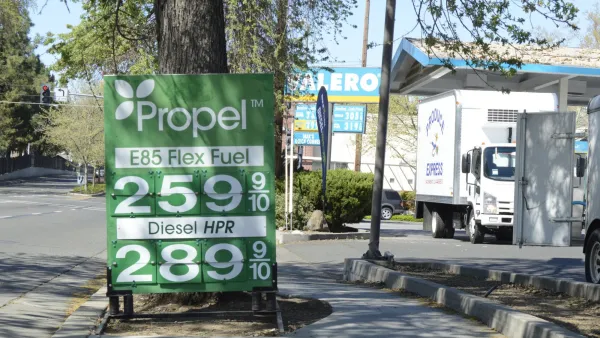
From Buses to Trains, Renewable Diesel Catches On in California
For almost two years, MUNI's diesel-powered buses in San Francisco have run entirely on renewable diesel fuel. Diesel-powered Amtrak trains running from San Jose to Sacramento could be next.
San Francisco's Diesel Bus and Truck Fleet Just Got Much Greener
San Francisco's diesel vehicles have been using a biodiesel blend for years, but in a move that illustrates the differences among biofuels, Mayor Ed Lee announced that the fleet will now use 100 percent renewable diesel fuel.
California Doubles Carbon Intensity Reduction Requirement for Transportation Fuels
California regulators have found that transportation emissions are the most difficult to reduce, unlike those from electricity generation. The state just took a major step by approving significant changes to its Low Carbon Fuel Standard program.

Planetizen Federal Action Tracker
A weekly monitor of how Trump’s orders and actions are impacting planners and planning in America.

The state-sanctioned urbicide of Austin
People don’t kill cities. Freeways do.

US to reduce Colorado River water deliveries to Mexico
A new Colorado Treaty amendment reduces Mexico’s Colorado River water allocation by 250,000 acre feet.

5 New England states march closer to 800 megawatt wind energy project
Securing federal approval for the project may be complicated under the Trump administration, which has historically been hostile towards domestic wind power.

Baltimore to break ground on $50 million Transit Priority Project
The project will bring faster bus trips, safer streets and better bike connections to Baltimore.

Airbnb launches $250 million 'last-dollar financing' housing accelerator, makes first investment in Austin
The company will put $6.4 million towards affordable housing development in Texas’ capital.

FREE Course: Walkable City 1: Why Walkability?
After describing his path towards focusing on walkability as the essence of good planning, Jeff Speck marches through his five principal reasons for making more walkable places.
Reinventing Malls: Planning Alchemy—Turning Gray Fields Into Gold
The course focuses on the opportunities and imperatives that shape reinvention of mall sites.

Eagle County Government
Harvard University Graduate School of Design
Nashville Planning Department
The Architects Foundation
University of Cincinnati Online
The Pocatello Development Authority
The Urban Renewal Agency of the City of Pocatello
Journal of the American Planning Association