After a protracted controversy, the United States Olympic Committee officially terminated the bid for Boston to host the 2024 Summer Olympic Games.


"After a tortuous seven-month public process, the United States Olympic Committee on Monday acknowledged that it had failed to win over the people of Boston to host the 2024 Summer Games and it officially pulled the plug on its bid to put forth Boston as America’s host city," reports Katharine Q Seeyle.
Scott Blackmun, the chief executive of the U.S.O.C., explained that the decision resulted from a lack of support from the citizens of Boston.
"The decision followed a bombshell announcement Monday morning by Mayor Martin J. Walsh that he would not sign a host city contract with the U.S.O.C. if it wanted him to do so by the end of the day," adds Seeyle.
The U.S.O.C. also said that it would consider other cities for a 2024 bid. Los Angeles, San Francisco, and Washington, D.C. were the other finalists when the U.S.O.C. selected Boston.
Read the full story: Boston’s Bid for Summer Olympics Is Terminated
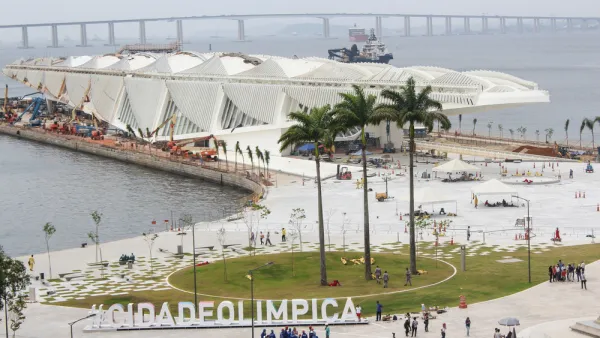
Abandoned Olympic Venues Cast Doubt on the Value of Hosting
Though cities hope for an economic boost, these photos show it's far from guaranteed.
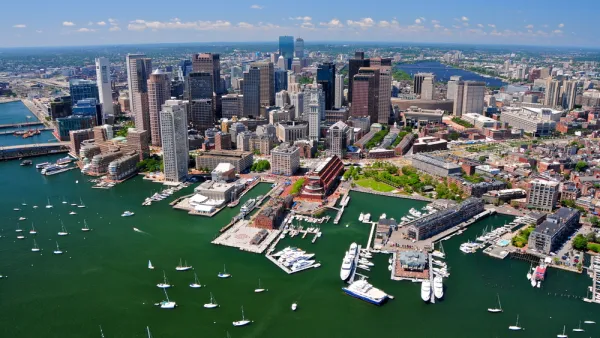
Boston Olympic Plan Includes 8,000 Units of Housing
As it vies to host the 2024 Summer Games, Boston's plan envisions two new permanent neighborhoods built with a mix of public and private investment. The final decision will take place in September.
Can the 2024 Olympics Help Boston Plan for a Better 2124?
Can the Olympic bid provide an impetus for long-range planning for the Boston metropolitan area?

Planetizen Federal Action Tracker
A weekly monitor of how Trump’s orders and actions are impacting planners and planning in America.

California plans to bury El Niño’s downpour
If the state plays its cards right, it may be able to store a billion acre-feet of El Niño’s water in aquifers.

Desperate measures: Advocates weigh draining Lake Powell to fill Colorado River
Draining the reservoir could reduce evaporation losses by a couple hundred thousand acre-feet.

Mamdani’s pied-à-terre tax survives legal challenge
A panel of judges found that the plaintiffs failed to demonstrate injury as a result of New York City's implementation of the tax.

Eastern Nebraska is running out of electricity
Data centers and electrification are straining eastern Nebraska’s grid, throttling economic development.

Seattle passes record-breaking transit services expansion
Proposition 1 will double the city’s transit tax to add 95,000 more bus trips and preserve 180,000 bus trips annually.

FREE Course: Walkable City 1: Why Walkability?
After describing his path towards focusing on walkability as the essence of good planning, Jeff Speck marches through his five principal reasons for making more walkable places.
Reinventing Malls: Planning Alchemy—Turning Gray Fields Into Gold
The course focuses on the opportunities and imperatives that shape reinvention of mall sites.

City of Rosemead
Rutgers University, Edward J. Bloustein School of Planning and Public Policy
One Hundred Miles
University of Michigan School for Environment and Sustainability (SEAS)
Hunter College, City University of New York (CUNY)
The Architects Foundation
City of Cambridge
Montrose County
The Pocatello Development Authority