The winner of a design competition in Paris, France could push the limit of wood design and construction much, much higher than it's gone before.


"Michael Green Architecture (MGA) just unveiled a proposal for a carbon neutral wooden skyscraper in Paris that, if constructed, will be the world’s tallest wood building," according to a post on Inhabitat.
"Created in collaboration with DVVD and real estate developer REI France, the wooden skyscraper—dubbed the Baobab—was designed as part of the city’s Réinventer Paris, a competition seeking innovative and environmentally friendly urban projects. The designers estimate the 35-story wood high-rise could sequester 3,700 metric tons of carbon—an amount equivalent to keeping 2,207 cars off the road for a year."
Michael Green Architecture is also the design force behind the T3 project in Minneapolis, which would build a seven-story, 210,000-square-foot office building made entirely of wood.
Read the full story: World’s tallest wood building proposed in Paris could store 3,700 metric tons of carbon

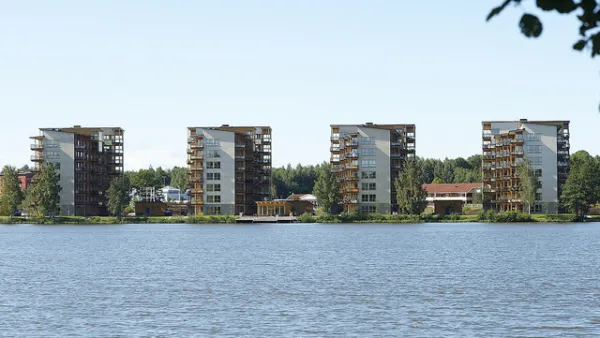
Nation's Tallest Wood Building Coming Soon to Portland
Portland, Oregon lives up to its reputation as a testing ground for urbanism innovation by approving what will become the nation's tallest wood framed building.
Wood Frame Construction Has Yet to Catch Up to Regulations in Toronto
When it comes to housing construction, the best intentions of regulators aren't always enough to sway the market.
Building Material of the Future: Wood
A proposed development in in the North Loop section of Minneapolis would be the first of its kind. According to the architect behind the design, the "T3" project, as its known, could be a harbinger of buildings to come.

Planetizen Federal Action Tracker
A weekly monitor of how Trump’s orders and actions are impacting planners and planning in America.

California plans to bury El Niño’s downpour
If the state plays its cards right, it may be able to store a billion acre-feet of El Niño’s water in aquifers.

Chicago breaks ground on $3 billion megadevelopment
The new neighborhood, titled Foundry Park, will one day host 3,700 residences.

California High-Speed Rail Authority CEO resigns after $600,000 scandal
Under Ian Choudri, the authority used taxpayer dollars to fund first class flights and trips to nightclubs.

Want to study the Missouri River? Soon, you may need unanimous approval from 10 states
Legislation would require 10 governors’ permission to study or build projects moving water outside the basin.

Desperate measures: Advocates weigh draining Lake Powell to fill Colorado River
Draining the reservoir could reduce evaporation losses by a couple hundred thousand acre-feet.

FREE Course: Walkable City 1: Why Walkability?
After describing his path towards focusing on walkability as the essence of good planning, Jeff Speck marches through his five principal reasons for making more walkable places.
Reinventing Malls: Planning Alchemy—Turning Gray Fields Into Gold
The course focuses on the opportunities and imperatives that shape reinvention of mall sites.

City of Rosemead
Rutgers University, Edward J. Bloustein School of Planning and Public Policy
One Hundred Miles
Hunter College, City University of New York (CUNY)
The Architects Foundation
University of Cincinnati Online
City of Cambridge
Montrose County
The Pocatello Development Authority