As the country's industrial past fades, cities are finding new meaning in their rivers—from the meandering to the mighty.


Jared Green provides a recap of some of the best ideas to come out of the recent "River Cities" event held at Dumbarton Oaks in Washington D.C. The event gathered landscape architects, academics, and urban planners to present their best ideas about an evolving field of study.
Green's summary focuses on the work of Vittoria Di Palma and Alexander Robinson, ASLA, both professors at University of Southern California, who provided a history tour of the Los Angeles River, from its past as the original, defining characteristic of the city of Los Angeles at its birth to its channelization and its ongoing rebirth.
Ray Gastil, head of planning for Pittsburgh, was on hand to discuss the Monongahela and Alleghany rivers, which have been the scene of a long and ongoing push and pull between industrial and recreational uses. Much of the progress in recovering riverfront areas has come through the implementation of the Three River Parks Plan.
Green adds another American river, the San Antonio River in San Antonio, Texas, as well as several European rivers to the list of case studies examined by the event.
Read the full story: River Cities Offer Lessons on How to Adapt

A New Master Plan for the Los Angeles River
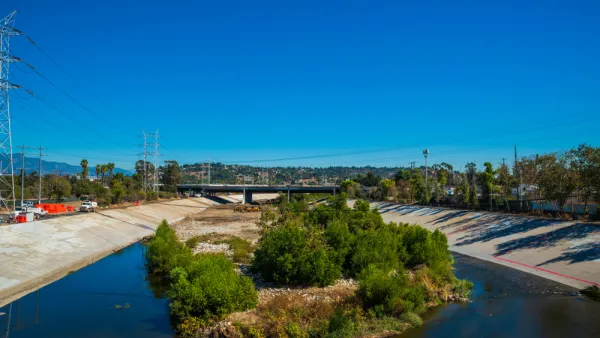
The L.A. County Board of Supervisors voted to approved a new master plan for the L.A. River—the “Reimagined River.”
A Comment for the L.A. River Master Plan
Five themes proposed to achieve justice and sustainability for the Los Angeles River and its surrounding communities.

Revealed: Three Park Design Proposals for Key L.A. River Parcel
Three design proposals have been unveiled for the Taylor Yards parcel along the L.A. River.

Planetizen Federal Action Tracker
A weekly monitor of how Trump’s orders and actions are impacting planners and planning in America.

California plans to bury El Niño’s downpour
If the state plays its cards right, it may be able to store a billion acre-feet of El Niño’s water in aquifers.

Chicago breaks ground on $3 billion megadevelopment
The new neighborhood, titled Foundry Park, will one day host 3,700 residences.

California High-Speed Rail Authority CEO resigns after $600,000 scandal
Under Ian Choudri, the authority used taxpayer dollars to fund first class flights and trips to nightclubs.

Want to study the Missouri River? Soon, you may need unanimous approval from 10 states
Legislation would require 10 governors’ permission to study or build projects moving water outside the basin.

Desperate measures: Advocates weigh draining Lake Powell to fill Colorado River
Draining the reservoir could reduce evaporation losses by a couple hundred thousand acre-feet.

FREE Course: Walkable City 1: Why Walkability?
After describing his path towards focusing on walkability as the essence of good planning, Jeff Speck marches through his five principal reasons for making more walkable places.
Reinventing Malls: Planning Alchemy—Turning Gray Fields Into Gold
The course focuses on the opportunities and imperatives that shape reinvention of mall sites.

City of Rosemead
Rutgers University, Edward J. Bloustein School of Planning and Public Policy
One Hundred Miles
Hunter College, City University of New York (CUNY)
The Architects Foundation
University of Cincinnati Online
City of Cambridge
Montrose County
The Pocatello Development Authority