The proposed Boulder Food Park repurposes a decrepit site into usable space for food truck patrons. Since the site is adjacent to a brick-and-mortar restaurant, a zoning exemption may be required.


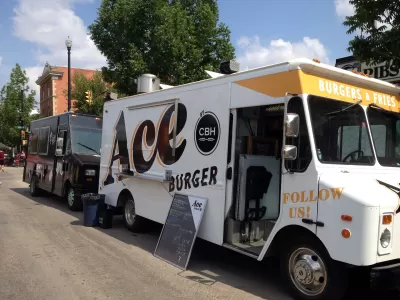
Providing a home for food trucks and their clientele, the Boulder Food Park idea includes indoor-outdoor seating, a bar, and a stage for live acts. But before the project can go forward, it requires "some sort of exemption to Boulder city code that doesn't allow food trucks within 150 feet of a brick-and-mortar restaurant. The property, which is less than 150 feet wide, backs up to Thai Shi House on 28th Street."
After initial trepidation, the restaurant's management warmed to the idea: "'Maybe in the beginning they will cause our business to go down, but I think they will bring more people to this area, more people walking by, and help people know about Thai Shi House.'"
The city has been hesitant to grant zoning exemptions, fearing an onslaught of special requests. But the food park idea enjoys support in the City Council.
Looking to boost "food truck culture," the city may authorize Boulder Food Park as a pilot project. "'Pilot project' has usually meant trying something for a limited amount of time, but it could also mean allowing something at one site and seeing how well it works before allowing it at other sites."
Read the full story: Boulder Food Park seeks 'creative solution' to food truck rules

Food Trucks, Already an Industry Force, Set for More Growth
A new report details the state of the mobile food vending industry and makes predictions for the short-term future.
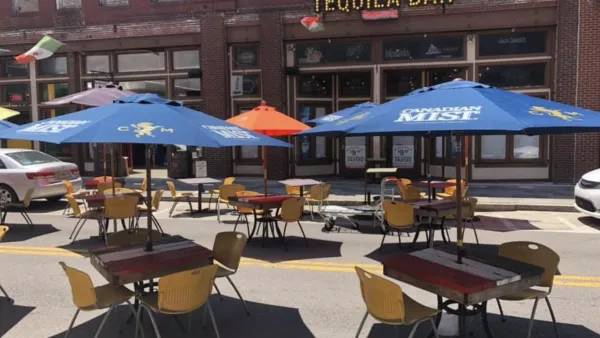
Tampa Closes Streets to Open Outdoor Space to Restaurants
A pilot project in Tampa is closing select streets to cars to allow more space for dine-in restaurant service.
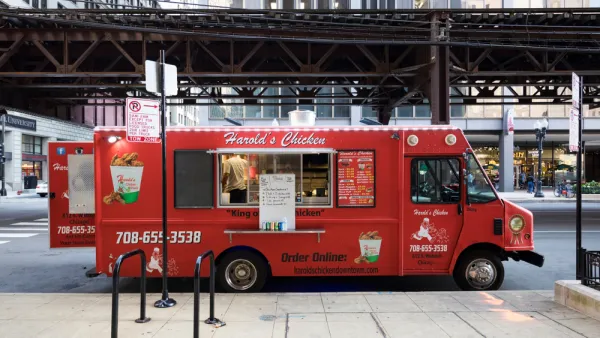
State Supreme Court Upholds Food Truck Regulations in Chicago
A question of whose business is suppressing whose in the city of Chicago was decided by the State Supreme Court.

Planetizen Federal Action Tracker
A weekly monitor of how Trump’s orders and actions are impacting planners and planning in America.

California plans to bury El Niño’s downpour
If the state plays its cards right, it may be able to store a billion acre-feet of El Niño’s water in aquifers.

Desperate measures: Advocates weigh draining Lake Powell to fill Colorado River
Draining the reservoir could reduce evaporation losses by a couple hundred thousand acre-feet.

Chicago voters approve permanent festival grounds, penalty for vacant property owners
Currently, major summer and fall festivals take over public parks for weeks at a time, drawing criticism from nearby residents

NYC votes to cut outdoor dining red tape, speed up permitting
New York City also voted to allow the Department of Transportation to begin work on urgent projects before notifying elected officials.

California appears to reject Prop. 45
The proposition would have expanded the projects that qualify for a streamlined environmental review, effectively paring down the California Environmental Quality Act.

FREE Course: Walkable City 1: Why Walkability?
After describing his path towards focusing on walkability as the essence of good planning, Jeff Speck marches through his five principal reasons for making more walkable places.
Reinventing Malls: Planning Alchemy—Turning Gray Fields Into Gold
The course focuses on the opportunities and imperatives that shape reinvention of mall sites.

City of Rosemead
Rutgers University, Edward J. Bloustein School of Planning and Public Policy
One Hundred Miles
Hunter College, City University of New York (CUNY)
The Architects Foundation
University of Cincinnati Online
City of Cambridge
Montrose County
The Pocatello Development Authority