Academics and professional planners have access to plenty of research and data to continue to improve and expand bikeshare systems around the world.


An article by Leighton Walter Kille shares some of the the findings of a 2015 research survey and analysis published in Transport Reviews, titled "Bikeshare: A Review of Recent Literature," which provides an overview of the state of research on bikeshare programs around the world.
After noting that the modern era of bikeshare commenced in 2005 with the launch of Velo'v in Lyon, France, the scale of such systems has exploded. According to Kille, "there are more than 850 public bikeshare system around the world, from Lansing, Mich., to New York City; from Melbourne, Australia, to Helsinki, Finland."
Kille goes on to detail some of the past research into the benefits of bikeshare before breaking down some of the details of the recent study. Findings are explained according to the following categories: 1) bikeshare growth and system size, 2) usage, 3) user preferences, 4) user demographics, 5) health impacts, and 6) system impacts.
Read the full story: Bikeshare systems: Recent research on their growth, users’ demographics and their health and societal impacts
Study: Bikeshare Replaces Transit Trips in Minneapolis, Washington D.C.
Eric Jaffe dives into evidence that bike share should be considered an essential component of a multi-modal public transit network.

Omaha's 400 shared e-bikes are now free to all residents
Before eliminating fares for locals, the Heartland system only recovered 10%-15% of its operating costs through fare revenue.
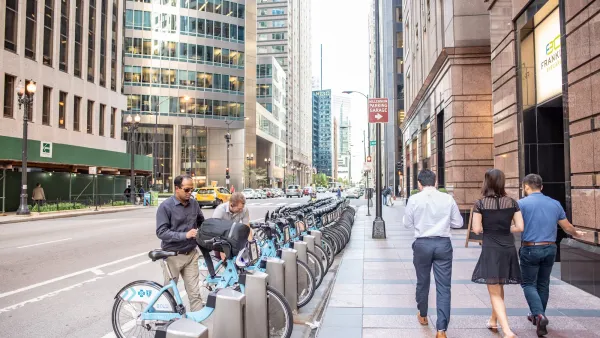
Chicago to Add or Upgrade 200 Bike Share Stations
The Divvy bike share system saw its highest ridership ever in 2025 with 6.8 million trips.

Planetizen Federal Action Tracker
A weekly monitor of how Trump’s orders and actions are impacting planners and planning in America.

Washington state to charge fee to drivers with fuel-efficient cars
Revenue from the fee will go towards supporting the state’s highways.

Illinois considers spending $1 billion in taxpayer money on data center
A quantum computing campus and data center are currently under construction in Chicago.

People Mover delayed again, LAX and contractor trade barbs
The automated train was last slated to open in January 2027.

Trump to blast ‘hydrocarbon highway’ through ‘world’s longest art gallery’
Environmental and historic preservation groups are suing to stop the project.

25 states cast bids to be the home of U.S. Space Academy
The academy will train scientists, officers and astronauts for the U.S. Space Force.

FREE Course: Walkable City 1: Why Walkability?
After describing his path towards focusing on walkability as the essence of good planning, Jeff Speck marches through his five principal reasons for making more walkable places.
Reinventing Malls: Planning Alchemy—Turning Gray Fields Into Gold
The course focuses on the opportunities and imperatives that shape reinvention of mall sites.

City of Charlotte
City of Rosemead
Rutgers University, Edward J. Bloustein School of Planning and Public Policy
University of Michigan School for Environment and Sustainability (SEAS)
Hunter College, City University of New York (CUNY)
The Architects Foundation
University District Partnership