According to Brookings, this research is intended to inform local debates over the minimum wage. Drawing on Census data, the report finds that astronomical income gains are still concentrated among the biggest cities.



Despite tangible gains in many sectors of the economy, cities still face high levels of inequality. This report from Brookings uses U.S. Census data to examine the current state of unequal incomes on the municipal level. Some extracts from the findings include:
- "Across the 50 largest cities, households in the 95th percentile of income earned 11.6 times as much as households at the 20th percentile, a considerably wider margin than the national average ratio of 9.3."
- "Several cities witnessed dramatic growth in the incomes of their highest-earning households between 2012 and 2013. In 12 cities, incomes for the 95th percentile of households in 2013 exceeded those in 2012 by a statistically significant margin. Seattle topped the list with 15 percent growth in income among those households, equivalent to a $36,000 increase."
- "About one in five of the nation’s largest cities posted significant income gains at the lower end of the distribution between 2012 and 2013. Jacksonville, San Francisco, Nashville, Tenn., Oklahoma City, and Kansas City, Mo. all posted double-digit increases in 20th-percentile incomes.
Read the full story: Some cities are still more unequal than others — an update

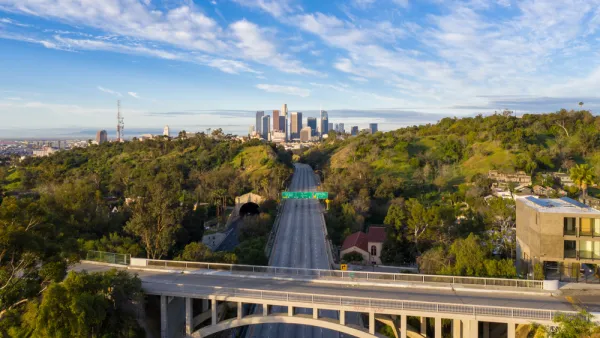
The California Dream is Becoming Less Achievable
Anti-growth forces have made it close to impossible for many young people and newcomers to gain the upward mobility that has defined the state's success.

Why the McMansion Isn't Really Back
Joe Cortright criticizes reports linking high median new home sizes to a renewed demand for McMansions. The market for single-family homes, he argues, locks out buyers of modest means. Only the well-off are buying.
Fracking Permits Temporarily Halted in North Carolina
Natural gas drilling was recently approved in North Carolina, but new operations are now on hold until the state Supreme Court resolves an issue about the process for appointing environmental review positions.

Planetizen Federal Action Tracker
A weekly monitor of how Trump’s orders and actions are impacting planners and planning in America.

Amtrak, CN end decades-long dispute with eight-year agreement
The new operating agreement establishes an updated framework for the companies to work together, including processes to resolve disputes.

Judges permit Denver to divert 77,000 acre feet from the Colorado River for reservoir expansion
Overuse and climate change have caused the Colorado River’s water levels to plummet.

NYC DOT wants faster, more permanent street upgrades
The city is examining ways to build more concrete infrastructure without getting entangled in 'decades-long' projects.

'Something we’ve never seen before:' rising utility rates could strain city finances nationwide
Data centers, climate change and other factors have caused utility rates in the United States to increase by 38% since 2020.

Trump to overrule local leaders, lease millions of acres of America’s Pacific Island territories’ seafloors to mining companies
International law says that the Indigenous people of America’s territories have a right to prior and informed consent regarding projects that impact their countries.

FREE Course: Walkable City 1: Why Walkability?
After describing his path towards focusing on walkability as the essence of good planning, Jeff Speck marches through his five principal reasons for making more walkable places.
Reinventing Malls: Planning Alchemy—Turning Gray Fields Into Gold
The course focuses on the opportunities and imperatives that shape reinvention of mall sites.

Harvard University Graduate School of Design
KFH Group Inc.
Greater Baltimore Committee
The Architects Foundation
University of Cincinnati Online
The Pocatello Development Authority
The Urban Renewal Agency of the City of Pocatello