A development proposal for a 1,450 glass skyscraper adjacent to Grand Central Station prompted the Architectural Record to wonder whether New York is chipping away the "Beaux Arts heart" of Manhattan.


According to Cara Greenberg, "preservationists are dismayed about Grand Central’s future next-door neighbor to the west, which is almost certain to be Midtown’s tallest tower, Kohn Pedersen Fox’s (KPF) One Vanderbilt , a 1,450-foot glass skyscraper with an asymmetrical façade."
"Occupying the block bounded by 42nd Street, 43rd Street, Vanderbilt, and Madison Avenues, the new tower will replace several historic buildings, including the 1912, 200-foot masonry structure at 51 East 42nd Street by Warren & Wetmore, Grand Central’s architects, the last of the remaining original buildings designed to frame the station in a complementary Beaux Arts style."
But central to the possibility of One Vanderbilt achieving its desired 30 FAR, is a proposal by the New York City Department of City Planning to upzone the Vanderbilt Corridor, "a five-block stretch running along Grand Central’s eastern side," from its current 15 FAR maximum to 30 FAR. Greenberg's concern, and the concern of preservationists in New York, is that the upzoning would pave the way for more new tower development that alter the context of Grand Central Station and other historic and famous buildings in the area, such as the Chrysler Building.
If you're interested in tracking the upzoning proposal as a possible indicator for the future of the New York City skyline, Greenberg provides the following about the current status of the proposal: "At present, the proposal is in the office of Manhattan Borough President Gale Brewer, awaiting her recommendation; it then heads to the City Council, with final votes to be taken around mid-year."
Read the full story: City Chips Away at Beaux Arts Heart of Manhattan

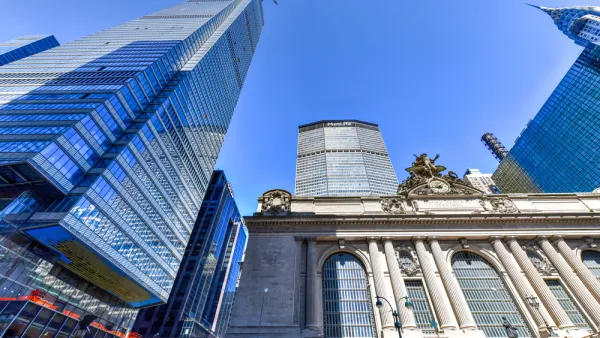
New Supertall Planned for Grand Central Station-Adjacent Property
A new supertall skyscraper will rise at 175 Park Avenue, rising next to famous neighbors on a prime block in Manhattan.
High-Rise Approval Secures $220 Million for Grand Central Terminal Improvements
In exchange for the approval to build One Vanderbilt, a 63-story office tower adjacent to Grand Central Terminal, the developer will give the MTA $220 million for upgrades to entrances of the Metro-North Railroad and the terminal's subway entrances.
NYC Rezoning Plan Reinstated Despite Lack of Racial Impact Analysis
The New York Appellate Division's First Department made short work of a ruling that reinstated the Inwood NYC Action Plan, which a lower court dismissed in December 2019.

Planetizen Federal Action Tracker
A weekly monitor of how Trump’s orders and actions are impacting planners and planning in America.

Amtrak, CN end decades-long dispute with eight-year agreement
The new operating agreement establishes an updated framework for the companies to work together, including processes to resolve disputes.

Northwest rail fans eager for Sept. 30 debut of Amtrak’s Airo fleet
Get ready for that new train smell and more seats. But they won’t go faster or run more frequently on the Cascades route in Washington and Oregon.

Brightline Florida files for bankruptcy
The transit company is over $5 billion in debt.

St. Louis Metro to test if single-car trains can reduce operating costs, maintain rider satisfaction
The pilot program will run from October to spring 2027, and begin with one single-car train operating on Metrolink’s Red and Blue lines.

Pennsylvania is building data centers in abandoned mines
Housing data centers in mines provides an alternative to destroying local forests and may spare residents from data centers’ noise and air pollution.

FREE Course: Walkable City 1: Why Walkability?
After describing his path towards focusing on walkability as the essence of good planning, Jeff Speck marches through his five principal reasons for making more walkable places.
Reinventing Malls: Planning Alchemy—Turning Gray Fields Into Gold
The course focuses on the opportunities and imperatives that shape reinvention of mall sites.

City of Thousand Oaks
City of Wisconsin Rapids
Harvard University Graduate School of Design
The Architects Foundation
University of Cincinnati Online
The Pocatello Development Authority
The Urban Renewal Agency of the City of Pocatello