A scathing critique of the land use, development, and transportation decisions of the Cleveland Clinic calls out the medical center for neglecting its role in the prioritizing healthy communities.


"Disappointing but not entirely surprising news from the Cleveland Clinic. Cleveland’s largest employer recently announced that it is closing Lakewood Hospital, in the cozy inner ring suburb, as it expands operations in sprawling Avon," according to a post by Angie Schmitt for Rustwire.
"This seems to be fitting with the nonprofit’s model of building a new hospital at every interchange opened in the sprawling hinterlands while winding down its hospital locations in the more populous areas of the region."
Especially telling to Schmitt is the decision to build a $36 million parking garage. She notes that there are several options that the hospital could have chosen more in line with its mission of providing quality healthcare, including rewards for employees who carpool and providing incentives for employees to live near their work. About these ides and the others Schmitt offers, she notes hurts the hospital's employees and the surrounding community.
Read the full story: The Cleveland Clinic Just Doesn’t Get it

Another State (Ohio) Gets It Right
Washington and California have been praised for early efforts to mitigate community spread of the novel coronavirus, resulting in relatively low rates of infection, hospitalization, and ultimately, death. Add Ohio to the bunch.
Cleveland Clinic Lacks a Prescription for its Community
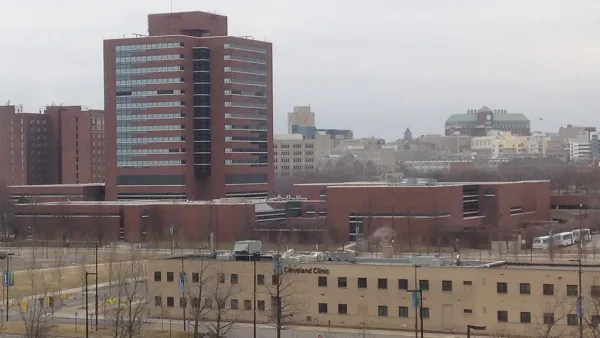
According to an article by Dan Diamond, the Cleveland Clinic is a worldwide success story, but the community surround the hospital "remains mired in poverty."
Building Demolished Without Review Was in Gap Between Protected Districts
The City of Cleveland has designated design review districts that require a hearing before demolishing potentially significant buildings. The Chester Conference Center, and most of the Cleveland Clinic campus, lie in-between protected districts.

Planetizen Federal Action Tracker
A weekly monitor of how Trump’s orders and actions are impacting planners and planning in America.

Amtrak, CN end decades-long dispute with eight-year agreement
The new operating agreement establishes an updated framework for the companies to work together, including processes to resolve disputes.

Judges permit Denver to divert 77,000 acre feet from the Colorado River for reservoir expansion
Overuse and climate change have caused the Colorado River’s water levels to plummet.

Boston has spent millions making the Green Line more accessible — and there’s no end in sight
While the city has invested millions into expanding and adding platforms to the Green Line to make it more accessible, new train cars set to arrive next year will be too tall for disabled passengers to board without raising the current platforms.

Idaho may see an 18% drop in federal surface transit funding — the largest estimated cut in the US
Transit systems in rural communities are much more reliant on federal funding to provide their services.

How ‘post-disaster gentrification’ alters neighborhoods after natural calamities
After hurricanes, fires or other calamities, the original residents of a community are often replaced by younger, wealthier residents.

FREE Course: Walkable City 1: Why Walkability?
After describing his path towards focusing on walkability as the essence of good planning, Jeff Speck marches through his five principal reasons for making more walkable places.
Reinventing Malls: Planning Alchemy—Turning Gray Fields Into Gold
The course focuses on the opportunities and imperatives that shape reinvention of mall sites.

City of Wisconsin Rapids
Harvard University Graduate School of Design
KFH Group Inc.
The Architects Foundation
University of Cincinnati Online
The Pocatello Development Authority
The Urban Renewal Agency of the City of Pocatello