Two proposals for library makeovers in Brooklyn tie into a larger narrative about development, and architecture, in New York City.


"Two proposals to sell and develop local library sites are wending through the Brooklyn Public Library pipeline, and, predictably, opponents have manned the barricades, citing the usual arguments about selling off public land to rapacious developers," reports New York Times Architecture Critic Michael Kimmelman before providing a review that trends toward a judgment of "promising" for the proposals.
"One plan envisions updating, but shrinking, a branch in Brooklyn Heights built in the 1960s. The other overhauls a popular, decrepit branch, from the 1970s, in Sunset Park. Both involve housing, a fair chunk of it subsidized, mostly on top of new storefront libraries."
The review of the proposals provides a lot of background and history on the art of the deal when it comes to libraries as real estate assets. One sign of a new era in library planning for New York is the de Blasio Administration's ongoing project to develop a ten-year capital investment plan for the system, the first of its kind. Kimmelman recommend that such public investments provide an excellent opportunity to "double down on the Design and Construction Excellence initiative, which hires local architects for public buildings."
Read the full story: Evolution for Libraries in Brooklyn

‘Emergent City’ Documentary Highlights Rare Anti-Gentrification Victory
The film charts the saga of a Brooklyn site called Industry City.
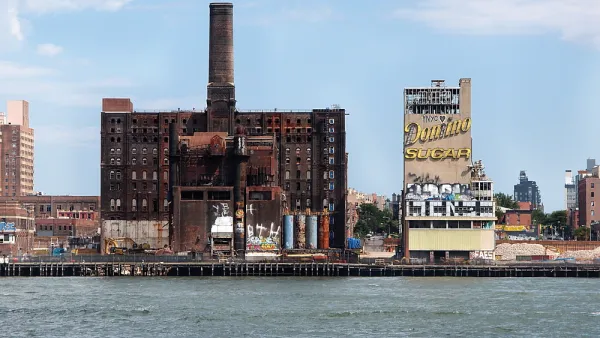
A New Riverfront Park in New York City
A new park on the East River in Williamsburg adds "one hell of an amenity" to Brooklyn.
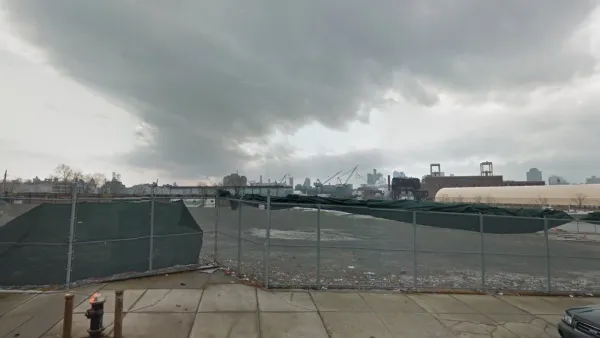
The de Blasio Administration Stays Firm on Waterfront Rezonings
Despite its ambitious housing targets, the de Blasio Administration isn't willing to sacrifice more of its prime industrial spaces, and the jobs they bring, in the name of residential development.

Planetizen Federal Action Tracker
A weekly monitor of how Trump’s orders and actions are impacting planners and planning in America.

Eastern Nebraska is running out of electricity
Data centers and electrification are straining eastern Nebraska’s grid, throttling economic development.

Study reveals best places in the U.S. for cycling, walking
New research from Streetlight Data examines bicycle and pedestrian miles per capita in the 100 largest U.S. cities by population.

Federal government nominates new FTA administrator
Mark Aesch is currently the founder and CEO of a transportation management consulting firm.

Developers reveal $10 billion stadium plan as ‘Hail Mary’ to keep Bears in Chicago
The plan would also boast a public park, high- and mid-rise buildings and a youth sports complex.

As Texas embraces carbon storage, a Black community questions the risks
Texas now issues permits for companies to store carbon dioxide underground. East Texas residents fear safety risks, and skeptics doubt the climate benefits.

FREE Course: Walkable City 1: Why Walkability?
After describing his path towards focusing on walkability as the essence of good planning, Jeff Speck marches through his five principal reasons for making more walkable places.
Reinventing Malls: Planning Alchemy—Turning Gray Fields Into Gold
The course focuses on the opportunities and imperatives that shape reinvention of mall sites.

City of Rosemead
Rutgers University, Edward J. Bloustein School of Planning and Public Policy
One Hundred Miles
University of Michigan School for Environment and Sustainability (SEAS)
Hunter College, City University of New York (CUNY)
The Architects Foundation
City of Cambridge
The Pocatello Development Authority
The Urban Renewal Agency of the City of Pocatello