Even local officials who prefer to talk about the fiscal rebound of their cities will not be able to accept escalating inequality as a byproduct of urban growth forever.


By Keli Tianga
In a recent Rooflines post, Sarah Treuhaft holds up new, reputable data that finds that inequality is not a circumstance of economic success, after all, but that it actually has a dampening effect. Specifically, the widening gap between the poor and lower middle class (households in the bottom 40 percent of the income distribution) and everyone else had the biggest negative impact on growth. Treuhaft’s takeaway is that increased inclusion and equity will lead to sustained growth of economies, so practitioners in community development and related sectors should stop working under the shadow of old research and actively work to help shift the paradigm.
Making a similar but somehow altogether different argument is...
Read the full story: “Inequality Happens?” Hopefully Not

Inequality and Informality in New York
For a MoMA exhibition about urban inequality, Brooklyn architects SITU Studios documented informal housing in New York.
Say it Loud: Inequality is Bad for Everyone
There is an invisible culprit in the great scandal of inequality in America: your Econ 101 textbook. Go ahead, dig it out from that storage chest, and undoubtedly you’ll read that inequality, while we might not like it, is good for economic growth
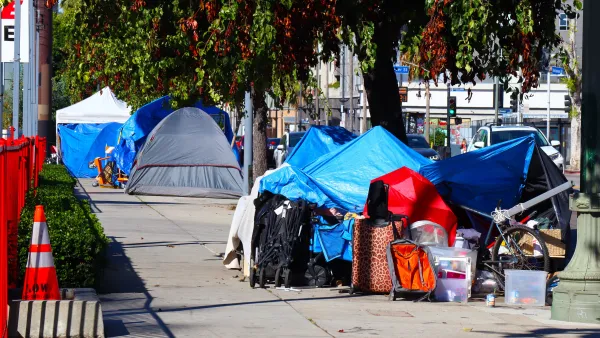
Los Angeles rescinds twelve 'anti-camping zones'
The zones previously prohibited unhoused people from camping in parts of Hollywood.

Planetizen Federal Action Tracker
A weekly monitor of how Trump’s orders and actions are impacting planners and planning in America.

Amtrak, CN end decades-long dispute with eight-year agreement
The new operating agreement establishes an updated framework for the companies to work together, including processes to resolve disputes.

Judges permit Denver to divert 77,000 acre feet from the Colorado River for reservoir expansion
Overuse and climate change have caused the Colorado River’s water levels to plummet.

NYC DOT wants faster, more permanent street upgrades
The city is examining ways to build more concrete infrastructure without getting entangled in 'decades-long' projects.

'Something we’ve never seen before:' rising utility rates could strain city finances nationwide
Data centers, climate change and other factors have caused utility rates in the United States to increase by 38% since 2020.

Trump to overrule local leaders, lease millions of acres of America’s Pacific Island territories’ seafloors to mining companies
International law says that the Indigenous people of America’s territories have a right to prior and informed consent regarding projects that impact their countries.

FREE Course: Walkable City 1: Why Walkability?
After describing his path towards focusing on walkability as the essence of good planning, Jeff Speck marches through his five principal reasons for making more walkable places.
Reinventing Malls: Planning Alchemy—Turning Gray Fields Into Gold
The course focuses on the opportunities and imperatives that shape reinvention of mall sites.

Harvard University Graduate School of Design
KFH Group Inc.
Greater Baltimore Committee
The Architects Foundation
University of Cincinnati Online
The Pocatello Development Authority
The Urban Renewal Agency of the City of Pocatello