The Northern Avenue Bridge in Boston—a 100-year-old swing bridge used by pedestrians and cyclists—was closed abruptly due to structural defects.


Boston "has closed the Old Northern Avenue Bridge, citing 'deterioration beyond repair' to the floor beams," reports Nicole Duncga. "The city offered no clear plans for the future of the 640-foot steel and concrete span across the Fort Point channel, raising fears that it may not be returned to service." Duncga also adds that it's the second bridge in Boston to close down abruptly since October.
"For years, the Old Northern Avenue Bridge teetered on the brink of demolition as city officials pointed out drawbacks in continuing to maintain it. But preservationists say the bridge, constructed in 1908, is one of the state’s few 'swing' bridges, spans that rotate horizontally when water traffic needs to pass."
Shirley Leung has also written a column that editorializes the political context about the bridge's history, as well as its potential future.
Read the full story: City closes Northern Avenue Bridge in South Boston
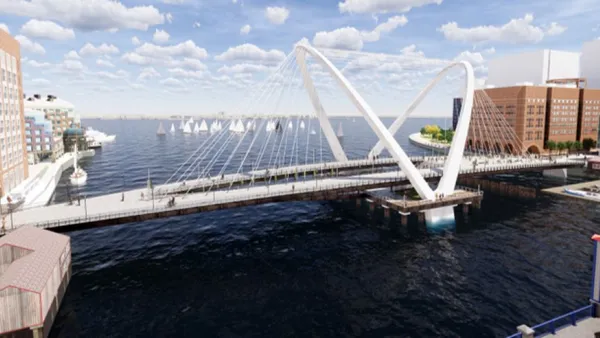
New North Avenue Bridge in Boston Would Ban Cars
The "people first" design favored by the city of Boston would not allow for cars on the planned North Avenue Bridge replacement.
Boston is hard to build housing in: its chief of planning wants to keep it that way
Chief of Planning Kairos Shen said she would not make changes to Boston’s affordability requirements for new housing, which critics say have slowed down development.
Learning loss and urban schools, part 2
Did test scores in progressive cities drop more post-COVID than test scores in moderate ones?

Planetizen Federal Action Tracker
A weekly monitor of how Trump’s orders and actions are impacting planners and planning in America.

California plans to bury El Niño’s downpour
If the state plays its cards right, it may be able to store a billion acre-feet of El Niño’s water in aquifers.

Desperate measures: Advocates weigh draining Lake Powell to fill Colorado River
Draining the reservoir could reduce evaporation losses by a couple hundred thousand acre-feet.

US buildings threatened, destroyed by fires set to triple by 2060
Researchers found a high fire risk for socioeconomically vulnerable neighborhoods in the American West.

LA residents may be allowed to paint their own crosswalks
Councilwoman Katy Yaroslavsky put out a motion instructing the Los Angeles Department of Public Transportation to study the feasibility of allowing volunteers to paint crosswalks.

Dallas moves to overhaul its zoning code
The city's zoning reform will allow more multi-family and mixed-use developments.

FREE Course: Walkable City 1: Why Walkability?
After describing his path towards focusing on walkability as the essence of good planning, Jeff Speck marches through his five principal reasons for making more walkable places.
Reinventing Malls: Planning Alchemy—Turning Gray Fields Into Gold
The course focuses on the opportunities and imperatives that shape reinvention of mall sites.

City of Rosemead
Rutgers University, Edward J. Bloustein School of Planning and Public Policy
One Hundred Miles
Hunter College, City University of New York (CUNY)
The Architects Foundation
University of Cincinnati Online
City of Cambridge
Montrose County
The Pocatello Development Authority