The California Public Utilities Commission has ruled on the issue of who should pay the remaining costs after a radiation leak forced an early end to California's San Onofre nuclear plant in 2012.


Aaron Orlowski reports that "[electricity] customers will pay $3.3 billion for the premature closure of the San Onofre nuclear power plant, according to a settlement approved Thursday."
The ruling by the California Public Utilities Commission means that customers of Edison will pay off that bill until 2022. "Meanwhile, San Onofre’s owners will pay $1.45 billion" and accept a "significantly lower return for the rest of its investment in San Onofre."
San Onofre, a nuclear plant located along the California coast at the northern end of San Diego County, was shut down in 2012 after regulators discovered a radiation leak. The unexpected closure came just a year after Edison and San Onofre's minority owner San Diego Gas & Electric invested in new steam generators, i.e., the reason for the hefty remaining costs.
Last May, the San Onofre plant was making news for difficulties arising from the plant's decommissioning, including the remaining $3.3 billion expense and the storage of highly radioactive nuclear waste.
Read the full story: Customers, here's your San Onofre bill: $3.3 billion

Small-Scale Nuclear Power Dealt Major Setback
The company that made history in January when its 'small modular nuclear reactor' became the first in the nation to receive certification from the Nuclear Regulatory Commission has canceled it due to financial reasons.
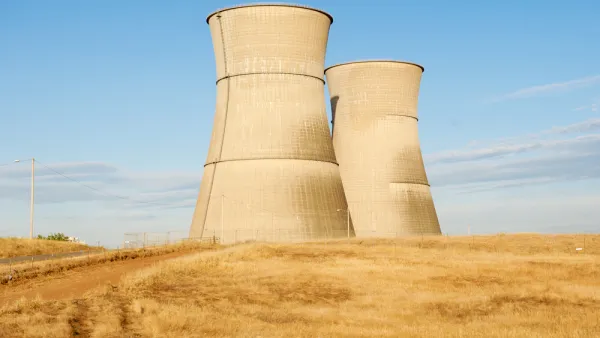
State-Level Decarbonization Lags Behind
With Donald Trump in office, the struggle against climate change may be up to the states. But are even the greenest states doing enough, especially as they continue shuttering nuclear plants?
Will Electric Utilities Disrupt the Oil Industry in California?
A key bill had language allowing public utilities to enter into the electric vehicle charging industry—overlooked by the oil industry and a game-changer for EVs as it tackles one of their most formidable challenges.

Desperate measures: Advocates weigh draining Lake Powell to fill Colorado River
Draining the reservoir could reduce evaporation losses by a couple hundred thousand acre-feet.

Eastern Nebraska is running out of electricity
Data centers and electrification are straining eastern Nebraska’s grid, throttling economic development.

Move over, LA: St. Louis gears up for Olympics, invests millions in downtown redevelopment
The Missouri city will host the 2028 Olympic soccer group stage and knockout matches.

Mass. votes against statewide minimum lot size for single-family homes
Over 2 million residents voted on Question 7; it was decided by just over 30,000 votes.

Maryland’s $15 billion bridge project gains key approval
The Maryland Transit Authority said the project will create over 60,000 jobs and add $23 billion to the local economy.

‘No clear next steps’ for Chicago's permanent festival grounds
Eleventh Ward Ald. Nicole Lee has suggested Soldier Field as a possible location for the permanent event space.

FREE Course: Walkable City 1: Why Walkability?
After describing his path towards focusing on walkability as the essence of good planning, Jeff Speck marches through his five principal reasons for making more walkable places.
Reinventing Malls: Planning Alchemy—Turning Gray Fields Into Gold
The course focuses on the opportunities and imperatives that shape reinvention of mall sites.

City of Rosemead
Rutgers University, Edward J. Bloustein School of Planning and Public Policy
One Hundred Miles
University of Michigan School for Environment and Sustainability (SEAS)
Hunter College, City University of New York (CUNY)
The Architects Foundation
City of Cambridge
Montrose County
The Pocatello Development Authority