The approval process is revealing more details about a garden bridge designed by Thomas Heatherwick in London—what has emerged is less a park than a tourist attraction.


Oliver Wainwright reports that the proposed Garden Bridge in London will have very specific limitations on its use. For example, group of eight or more will require special permission to visit the bridge, riding bikes will be prohibited, and the bridge will be closed at night.
"Such a measure suggests that the garden bridge, as its critics have suspected, is not in fact a bridge – in the sense of being a public right of way across the river – but another privately managed tourist attraction, on which £60m of public money is to be lavished," writes Wainwright.
"Having received planning permission from Lambeth council last week – the first hurdle in a process that will be followed by Westminster’s decision next month, before swooshing across the mayor’s lubricated planning desk then passing under the nose of Eric Pickles – a series of conditions has emerged that make the project look rather less public than first imagined."
For those keeping track at home, the designer of London's proposed garden bridge is the same Thomas Heatherwick who has designed the recently announced Pier 55 offshore park plan in Manhattan—a connection that did not go unnoticed by Kriston Capps in an article this week about the prevalence of offshore parks in recent years.
Read the full story: London's garden bridge: the public park where groups and cyclists aren't welcome

Harley Davidson Includes Community Park in Headquarters Revamp
Milwaukee is about to get a major community space upgrade thanks to one of its most recognizable hometown brands.
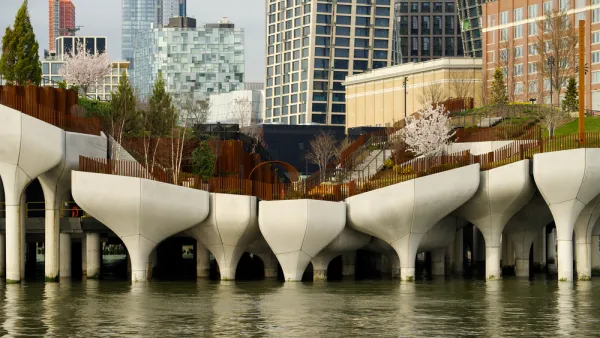
'Little Island' Opens as a Photogenic Addition to the Hudson River
Little Island came into the world as Pier 55 and even managed to come back from the dead before opening last week.
[Update] Plug Finally Pulled on the Pier 55 Project in Manhattan
A splashy proposed park to replace Pier 54 in New York City, designed by a starchitect and proposed by a famous billionaire, couldn't weather the storm of controversy in New York City.

Planetizen Federal Action Tracker
A weekly monitor of how Trump’s orders and actions are impacting planners and planning in America.

California plans to bury El Niño’s downpour
If the state plays its cards right, it may be able to store a billion acre-feet of El Niño’s water in aquifers.

Desperate measures: Advocates weigh draining Lake Powell to fill Colorado River
Draining the reservoir could reduce evaporation losses by a couple hundred thousand acre-feet.

Housing is the top priority of Seattle’s sole new councilmember
Jenks campaigned on building 1,000 new units of affordable housing.

New tax cuts may slash $1.5 billion in funding for Miami transit, public parks
Amendment 3 will save Miami-Dade homeowners $2,700 in 2028.

Arizona, Wisconsin, Pennsylvania hope to finally advance climate goals post-midterms
The three states have spent years under Republican or divided control.

FREE Course: Walkable City 1: Why Walkability?
After describing his path towards focusing on walkability as the essence of good planning, Jeff Speck marches through his five principal reasons for making more walkable places.
Reinventing Malls: Planning Alchemy—Turning Gray Fields Into Gold
The course focuses on the opportunities and imperatives that shape reinvention of mall sites.

City of Rosemead
Rutgers University, Edward J. Bloustein School of Planning and Public Policy
One Hundred Miles
University of Michigan School for Environment and Sustainability (SEAS)
Hunter College, City University of New York (CUNY)
The Architects Foundation
City of Cambridge
Montrose County
The Pocatello Development Authority